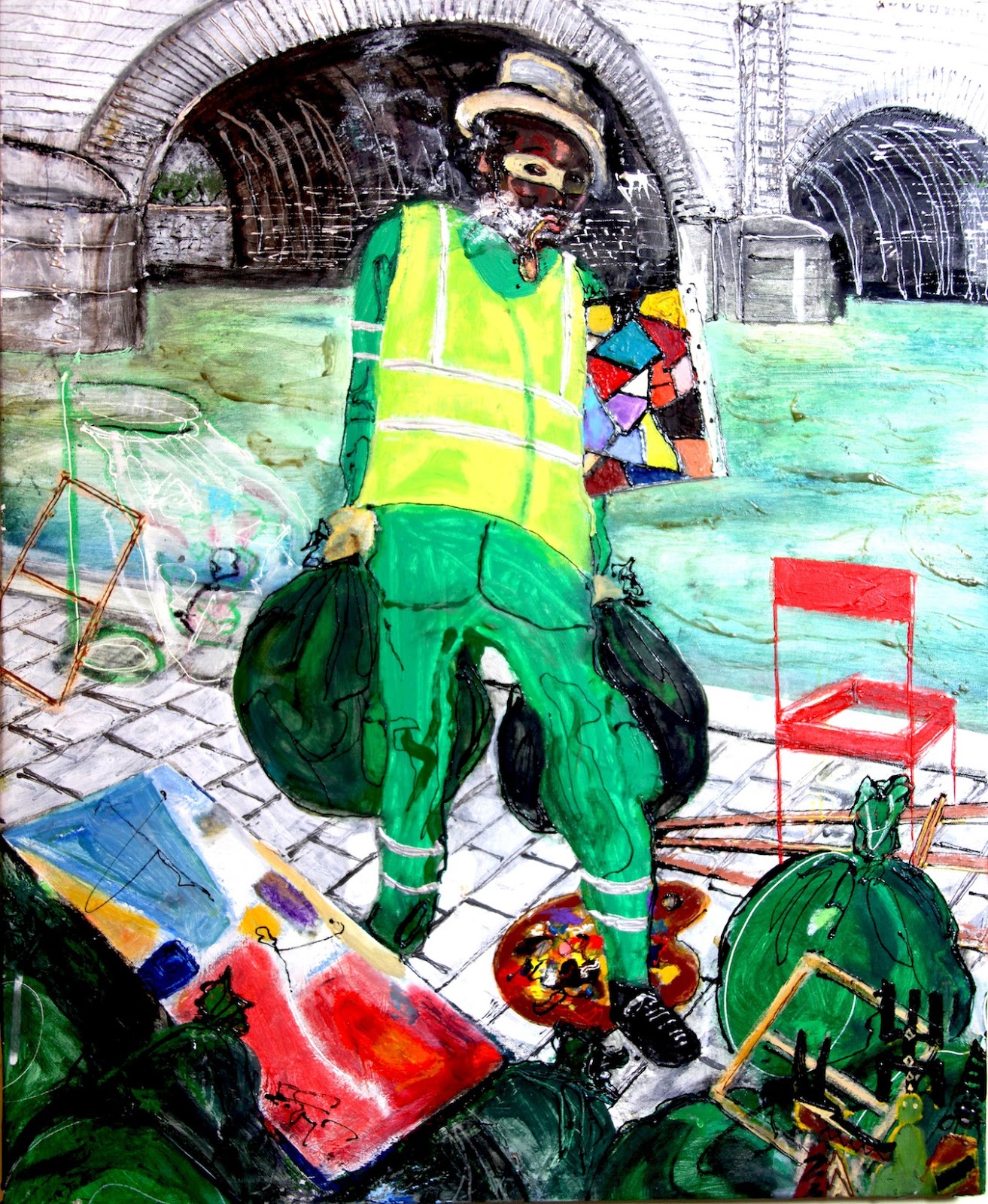
Last week I open a new series of Black Paris Profiles with the story of fellow Texan Ealy Mays. This week, Ealy talks about his family and his life in Paris in Part II of this Black Paris Profile.
 Ealy Mays
© Discover Paris!
ETBP: When did you move to Paris?
Ealy Mays: I started the process in mid 90s and officially moved in 1997.
ETBP: What brought you here?
Ealy Mays: Paris was another destination in my long expatriate life. After Mexico, my return to the United States re-affirmed my inability to live in America on several counts. I need an intellectual society to think, breathe, and to paint. My type of artwork is expression without borders. A black painter in America is often subjected to too many restrictions and barriers – much of which is imposed upon on us by our own people. In this age of political correctness, it would have been only a matter of time before I would have been sanctioned for some kind of a thought crime through my work, had I stayed in the United States.
ETBP: After all that you’ve experienced during your years of moving and painting around the world, why do you stay here?
Ealy Mays: First and foremost I am a father of a teenage daughter in Paris, and she needs her father. Additionally, I can paint what I want to paint in France. Art is still "art" in this country. Artistic expression is still one of the freest commodities in France, whereas in many countries, including the United States, I would have to conform to the bubble of so-called "black art" or what is "expected" of a black artist. No one is censuring me in France. Here I can paint Paris stories, Russian stories, Mexican stories, anything that I want.
Let me again invoke Richard Wright, who once said "there was more freedom in one block of Paris than in the whole of the United States." That is re-affirmed to me on each visit back home. My mind could never be as free to paint or to compose certain installations in most countries, as it is in France.
 Art Collectors I from the Paris series
2012 Acrylic on canvas
Image courtesy of the artist
I was reminded of this recently in a restaurant in my neighborhood where I was talking to some prospective collectors and showing them some of my work on the wall. An eavesdropping sister overheard our conversation and without even saying hello, she came up to me and asked me "if I ever thought of reflecting my own culture in my work by painting my own people."
Suffice it to say that my almost 40 years of narratives on black history, culture, and legacy, is unparalleled among contemporary artists. This woman knew nothing about my art beyond a few pieces in my friend's restaurant, yet she felt that she was entitled to make such an observation. But she was just being America failing to realize she was outside of America. She was a product of a rude, politically correct, and non-intellectual society that judges before it understands. Can you imagine the forces or censorship and politically correct inhibitors that are born down on many artists in America?
In France, people will start by first asking you about your artwork. In America, they start by visual condemnation, even before understanding the artist’s intent or message. Jacob Lawrence painted Hiroshima, though he was not Japanese. Paris gives me the freedom to mentally roam and create without barriers.
ETBP: A major theme of your Web site is the legacy of black literary and artistic development in Paris. Is a sojourn in Paris a "must" for artists who are developing their skills and their eye today?
Ealy Mays: The art scene for the young artist in Paris is not what it used to be, nor is it what it might be for the young writer. While Paris still holds the key to much intellectual stimulation and development, a young artist without local mentorship or guidance could easily be distracted in Paris, since access and inroads into the art scene are not as readily available now as they were 50, 100, or 150 years ago. The mere survival of an artist is dependent on a few things – selling, exhibiting, and media coverage are among the most important. The French state has certain minimal support for the artist but it has never support the commercial development of the artist.
For the writer it might be easier to come to Paris and thrive because the environment is so conducive to freely writing and to writing freely. For the young painter however, he might be able to paint freely in Paris but he may find that he is not
as able to freely paint in Paris if he is not a part of the system of galleries, symposiums, and residencies etc. This is an important distinction.
For young artists, I would recommend a start at the Cité des Arts, much like the one I had. There, they might be afforded the time and ability to somewhat integrate. But again, it should be made clear that the conditions and atmosphere that existed even a generation ago are no longer the same for the foreign artist arriving in France.
Despite what I've just described, I would be disingenuous to discourage any young artist from coming to France. There is something in France that shifts the paradigm of an artist; something that makes an artist thinks differently (you get the feeling Steve Jobs must have lived in France). My only caveat will be for any young artist coming to France to be realistic. Make sure you have the means to eat and pay your rent before you pack up and come. The Seine holds the body of many dead and deranged artists who were very fine painters yet could not feed or house themselves.
ETBP: Tell us about your family (parents, daughter).
Ealy Mays: My father was a doctor. My mother was a schoolteacher. I have one younger sister, two younger brothers, and two elder brothers (who are also doctors).
I am also the proud father of a 14-year-old daughter who is half French and being educated within the French system. I homeschool her on American culture and ensure that she spends vacations in the US with her grandmother, her aunt and uncles, and her extended cousins.
I come from a long family of intellectuals and independent-minded Texans. Famed educator Benjamin Mays is a distant relative. My grandmother, a violinist, housed the great diva Marian Anderson when Anderson performed in Texas and could not find a room in the whites-only hotels.
 Ealy and The Texas Last Supper
© Discover Paris!
My family has been in Texas for some 200 years, way before Texas became a state in the Union. We are proud Texans, albeit with strong and deep roots and connections to my hometown (and that of Paul Laurence Dunbar) of Dayton, Ohio, where my father chose to settle his family after medical school due to Ohio’s then strong industrial base and high quality of life for African Americans.
ETBP: You earned art certificates during your years in Dayton and yet you pursued a Batchelor’s degree in chemistry and biology at Wiley College and a medical degree at the University of Autónoma. Tell us how / why you abandoned your medical career to become an artist.
Ealy Mays: I was always an artist. My father was a doctor. My two older brothers became doctors. It seemed the logical thing to do to follow in my father’s footsteps. A son with high regards for his father will always feel a need to obtain his father’s ultimate approval by following in his footsteps. But the more I progressed in my medical studies, the more I wanted to paint, the more I realized that I painting was all I could do. I was and would always be an artist.
ETBP: Did your pursuit of the science and medical degrees represent a switch, or did you continue to pursue art while you were in college and med school?
Ealy Mays: No, it did not represent a switch at all. In fact while in Mexico, I continued to paint and to exhibit, such as annual exhibitions in the Fiestas de Octubre. I became the artist to many in the Mexican "moneyed" strata, who regularly commissioned me to paint portraits and masterpieces of Mexican scenery for their families. So established did I become as a local artist that I even assumed the name "Ealy Mayo" as a nod to legitimize myself as a local painter.
In 1989, my work
Last Train to Chihuahua took runner-up to first prize in the José Clemente Orozco annual art competition, which was one of the most famous art competitions in Mexico. It was speculated then that I lost out to the first prize due mainly to being a non-Mexican painter.
 Last Train to Chihuahua
1989 Oil on canvas
Image courtesy of the artist
Later on, meeting legendary and then aging Mexican painter Rufino Tamayo, who painted the red watermelon, influenced my decision to paint the blue watermelon, which I felt had more resonance and cultural implications for me. I saw the satirical value in that here was a Mexican giant who was painting watermelons where there were so many culturally stereotypical implications with the watermelon for me as an African American.
It was the same thought process for me with my Mammy series. Why should Andy Warhol make millions with his "Diamond Dust Mammies" from the objectified portrayal of the black maid? So I started to paint Mammy with a meaning – by highlighting her contributions to the evolution of the American society, being that she was the one who took care of us all, black and whites, and would sacrifice to see her offspring become mainstream in every echelon of American society – politics, law, sports, entertainment, education, literature, medicine, and science.
ETBP: Is your daughter a source of inspiration for your painting?
Ealy Mays: Yes of course. My daughter is my inspiration for living, and I am the only thing between her and a French identity of being a "brown French woman." From her father, she learns her identity as an African American and as a black woman in France and among the global diaspora.
ETBP: Do you have any final thoughts that you wish to share with those aspiring to become a professional artist?
The words of my father:
Imitate,
Initiate, and
Create. I would add, be original in thoughts, forms, and compositions. Try to create original forms. Create artwork from the social critic within, as opposed to work based on the needs and likes of the art critic in newspapers. Resist the urge to conform. Originality is essential to being an artist.
ETBP: You say that your father told him to imitate, initiate, and create. But you go on to talk about how important originality is, which would seem to contradict your father’s advice. Please elaborate on this.
Ealy Mays: Even in imitation, there is originality. Original forms may be created, renewed or evolved from old sources, or might emerge from the destruction of other forces. The dinosaurs gave way to us...yet one could argue that humanity is an original form. African art gave way to Picasso...yet he created original forms belied by imitations.
************
If you like this posting, share it with your friends by using one of the social media links below!