Showing posts with label Beauford Delaney. Show all posts

Thursday, October 6, 2016

The Color Line - Buzz

The vernissage (opening reception) for The Color Line was held on Monday, October 3, 2016 at the Musée du quai Branly.


This long-awaited exhibition provides a magnificent lens through which visitors can simultanously regard the sad history of segregation in the United States and a cross section of the monumental body of work that African-American artists have produced in spite of and because of it.

The vast majority of works were borrowed from museums and private collections in the U.S. and there is considerable buzz about the exhibition because of this. Numerous people have traveled to Paris to see it as a result. The Quai Branly Museum, Columbia Global Centers | Paris, and the Terra Foundation for American Art are among the organizations that have organized public events in celebration of the opening. Several private events were organized as well.

The Friends of Education of MoMA (Museum of Modern Art) in Manhattan sent a large group to Paris to attend the opening. They enjoyed a private reception at Galerie Intemporel, hosted by owner and independent curator Laurence Choko on Sunday evening, October 2. Distinguished guests included U.S. Ambassador to UNESCO Crystal Nix-Hines and prominent African-American art collector Dr. Walter O. Evans.

Dr. Walter O. Evans, Laurence Choko, and Linda Evans
© Discover Paris!

Dr. Evans has loaned several works from his personal collection to the exhibition.

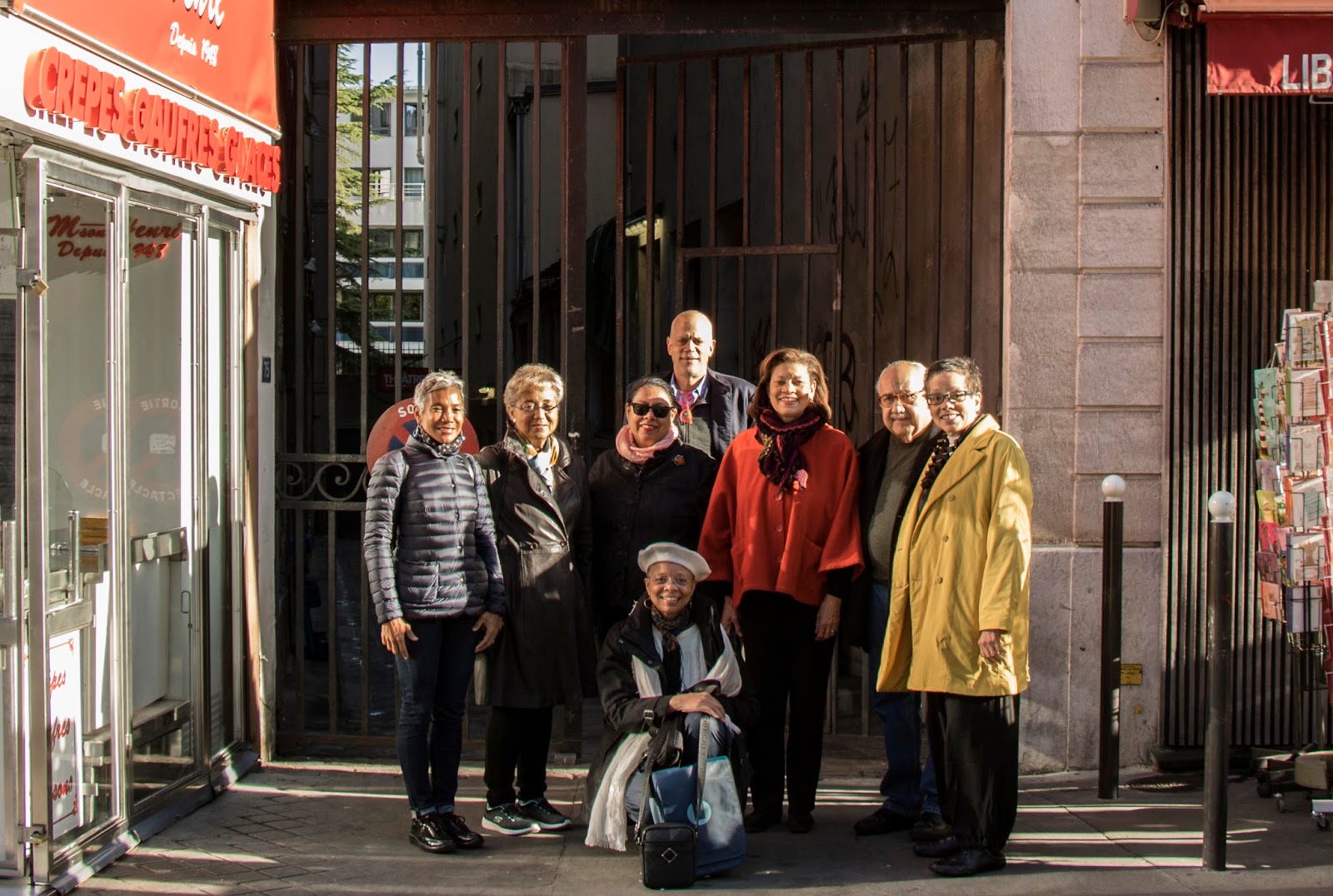
Several members of the Friends of Education of MoMA group enjoyed a private tour of Beauford Delaney's Montparnasse, a two-hour walking tour that explores the district where Delaney lived for most of his 26 years in Paris.

MoMA group on Beauford Delaney's Montparnasse walking tour
© Discover Paris!

Delaney's abstract portrait of Ella Fitzgerald, loaned by the SCAD Museum of Art in Savannah, hangs in the exhibition.

The Musée du quai Branly organized a pre-vernissage on Sunday, October 2 and a traditional vernissage on Monday, October 3. They have scheduled numerous events throughout the show's run through January 15, 2017.

The exhibition is rich, broad, and deep and will take several hours to see if you plan to do anything more than just walk through. I attended the opening reception on the evening of October 3 and can personally attest that this show is not to be missed!

The Color Line - collage
© Discover Paris!

Columbia Global Centers | Paris has organized a week-long series of events to coincide with the opening of the exhibition. Called "Race and Racism: Global Perspectives," it is being presented in partnership with the Columbia Masters Program in History and Literature in Paris. Attendees of the various events will enjoy music, dance, literature, and film. All events are free and open to the public. To register, click HERE.

The Terra Foundation of American Art has organized a dialogue between The Color Line's French curator, Daniel Soutif, and American scholar Richard J. Powell, who is the John Spencer Bassett Professor of Art & Art History at Duke University. This event, which is also free and open to the public, will take place on October 10, 2016 at 6:00 PM. Registration is required - to sign up, send e-mail to .

Discover Paris! is offering private, guided individual and group tours of The Color Line in English. For more information, click HERE.

************


Entrée to Black Paris!™ is a Discover Paris! blog.

If you like this posting, share it with your friends by using one of the social media links below!

Thursday, June 16, 2016

Ed Clark: Reflections on Life and Art in Paris

Each time I give a presentation on Beauford Delaney's Montparnasse or lead the walking tour of the same name that I inaugurated during the Resonance of Form and Vibration of Color exhibition that took place in February - March 2016, I talk about Ed Clark. He was a good friend of Beauford as well as a fellow artist.

In reviewing the blog post that I wrote about him - "Ed Clark - 'Broom-pusher' Artist" - I remembered that I did not use all the material that I gathered when I interviewed him several years ago. I'm bringing it to you today.


***********

Despite Montparnasse's long-established history of being an artist's haven, Ed Clark was not driven to seek lodging there when he moved to Paris on the G.I. bill in 1952. He would have lived anywhere in town, but by chance, he found a cheap room in the quartier.

He first settled in the Hôtel des Ecoles on rue Delambre (now the Hôtel Lenox Montparnasse), then moved into a top floor apartment across the street at Number 22. A skylight flooded the apartment with wonderful light that allowed Clark to use this as a studio. His building was occupied by others who were destined to become famous artists – among them Cardenas, one of Paris’ most famous expatriate sculptors, and Sugai, one of Japan’s most famous artists.

Courtyard at 22, rue Delambre
© Discover Paris!

Clark enrolled at the Ecole de la Grande Chaumière, which was very popular among students because it allowed creative expression that was not permitted at the prestigious Académie des Beaux-Arts (where several African-Americans also studied over the years). He described the Grande Chaumière as a “workshop school”, where students were not forced to attend classes. His experience there was different than at the Art Institute of Chicago, where there was constant interaction with students and work was critiqued daily.

Ecole de la Grande Chaumière
© Discover Paris!

Clark spoke fondly of two experiences there that spurred him onward toward excellence in his work. The first was a comment made by French artist and professor Edouard Goreg. Clark, who said that at the time he was determined to outpaint Michelangelo, was earnestly painting a nude model. Goreg came by to examine the work and critiqued Clark by saying “this smacks of the Academy (des Beaux-Arts).” Clark went on to relax his attempts at perfecting technique and allowed himself more freedom of expression in his painting. Goreg was to eventually judge Clark’s work at a show at Paris’ Gallery Craven in 1953, one of the rare exhibitions that featured American artists at that time.

Catalog cover
Peintres américains en France

The second incident occurred when Clark decided to try his hand at sculpture. Though devoted to painting, he decided to take a class in sculpture “because it was free.” He had the opportunity to sculpt the same model who posed for Rodin’s The Thinker. Clark’s professor for this class was none other than the Russian sculptor Ossip Zadkine, whose atelier in the 6th arrondissement in Paris was converted into a museum devoted to his work. Zadkine critiqued one of Clark’s sculptures by saying “I see that you’re a painter,” indicating that Clark’s approach to the medium and the art form was inadequate.

Clark describes himself as the first African-American painter to use large canvases for his works. The painting entitled The City (1953), measuring 51 x 77 inches, was his first such endeavor. He presented many such works at the 1954 exhibition entitled Grandes Toiles de Montparnasse that was sponsored by the American Center for Students and Artists. In 1955, he created a painting that measured 4 x 3 meters (~13 x 10 feet), which he said was the largest ever made in Europe at that time.


His work was favorably reviewed by Le Monde critic Michel Conil-Lacoste, which was significant given that the French took a negative view of art created by Americans at that time. But Clark’s gratification from this review was tainted by Lacoste’s referral to him as “a Negro of great talent,” a statement that could have been interpreted to mean that most blacks were not capable of having great talent. He met Lacoste at the café Select and asked why Lacoste had written this. Lacoste replied that he had not previously been aware that Clark was black, but that when he learned of Clark’s race, he reported it as a matter of fact, not of judgment. Lacoste was instrumental in getting Clark’s paintings into the Gallery Creuze, where he had a one-man show in 1955.

Interestingly, but perhaps not surprisingly, the Herald Tribune would not review Clark’s work.

Because of his fondness for his new-found lifestyle and the French capacity to “live and let live,” and also because of the success that he enjoyed with his first solo exhibition, Clark stayed in Paris after his G.I. benefits were depleted. But he ran out of money after the commercial failure of his second show and moved to New York with a group of artists to create a co-op avant garde gallery. The New York Times and other papers declined to review his work, as the Herald Tribune in Paris had done.

Clark credits his appreciation of the use of natural light and color, so important to the Impressionists, to his training in Paris. He has had numerous exhibits in Paris since the 1950s, and was one of the artists featured in the exhibition entitled Explorations in the City of Light: African-American Artists in Paris, 1945-1965 that traveled throughout the United States in 1996-97. The City graces the cover of the exhibition catalog.

Catalog cover
Explorations in the City of Light: African-American Artists in Paris, 1945-1965

Living in Paris and traveling throughout France has given Clark an original perspective on artistic expression and has influenced his approach to painting. He says that he would freely advise young artists to go to Paris “not for training (as I did), but for life”, but would warn them that it is difficult to earn a living there.

To sum up what Clark learned from his artistic training and experience in Paris, he states emphatically “Art must be more than correct – it must be beautiful!”

************


Entrée to Black Paris!™ is a Discover Paris! blog.

If you like this posting, share it with your friends by using one of the social media links below!

Thursday, June 2, 2016

International James Baldwin Conference in Paris

From Thursday, May 26 through Saturday, May 28, the American University of Paris opened its doors to scholars from around the world to celebrate the life and examine the writings of James Baldwin.


This phenomenal conference, entitled "'A Language to Dwell In': James Baldwin, Paris, and International Visions," was co-directed by Alice Mikal Craven and William E. Dow of the American University of Paris. Four plenary sessions and over 150 presentations in 44 concurrently running panels placed "special emphasis on the Paris Baldwin inhabited, both what it was and what it is today as a result of the marks he left behind."

The opening session was held in the sanctuary of the American Church in Paris. Seven scholars participated in a round table discussion on "Presence and Legacies: The State of Baldwin Studies." This was followed by a reception and a "Welcome Show" organized by Samuel Légitimus, director of Collectif James Baldwin - a French non-profit organization that has preserved and promoted Baldwin's legacy since 1993.

Panel for opening plenary session
© Discover Paris!

Samuel Légitimus, Director of Collectif Baldwin
© Discover Paris!

Welcome Show Performers - from left to right:
Inside Voices Choir, Gladys Arnaud (Sister Margaret - the Amen Corner),
Rick Odums Dancers
© Discover Paris!

Highlights of the conference included screenings of Joanne Burke's video documentary Paris Noir: African Americans in the City of Light and Karen Thorsen's documentary Price of a Ticket, as well as Jake Lamar's reading from his screenplay Brothers in Exile.

Jake Lamar reads from Brothers in Exile at the Hôtel Talleyrand
© Discover Paris!

I had the pleasure of presenting "Beauford and Baldwin: Paris Stomping Grounds" on Saturday afternoon. This talk featured the favored haunts of Beauford and Baldwin, with a focus on the Montparnasse and Saint-Germain areas of the city. I also spoke about the recent Beauford Delaney art exhibition at Columbia Global Centers, Reid Hall.

Monique shows the Beauford Delaney catalog
© Discover Paris!

I sat on a panel with Ed Pavlić of the University of Georgia, who presented a paper entitled "Who Can Afford to Improvise?: Black Music as Heard Listening Over Jimmy Baldwin's Shoulder." Pavlić looked at how music influenced Baldwin's writings and distributed a playlist of "music to accompany James Baldwin's career (and beyond)." During the question and answer period, he and I realized that we corresponded about Baldwin's Istanbul addresses eighteen months ago when I was preparing for a visit there. The information he shared with me helped me write the blog post that I published about my trip in March 2015. We were pleasantly surprised to have this opportunity to meet in person.

Monique Wells and Ed Pavlić shaking hands
© Discover Paris!

At the end of the conference, it was announced that a final international conference on Baldwin may be held in Istanbul within a couple of years. Previous conference venues include Montpellier, France (2014); New York City (2011), and Boston (2009).

************


Entrée to Black Paris!™ is a Discover Paris! blog.

If you like this posting, share it with your friends by using one of the social media links below!

Thursday, March 3, 2016

Beauford Delaney's Montparnasse - Entrée to Black Paris' Newest Walking Tour

When I organized the Beauford Delaney: Resonance of Form and Vibration of Color art exhibition at Columbia Global Centers | Paris at Reid Hall, I created a new Entrée to Black Paris walking tour to honor the artist.

Beauford Delaney
© Carl van Vechten 1953

Beauford moved to Paris in 1953 and died here in 1979. For the majority of these years, he lived in the historic artists' district called Montparnasse. The walk features his homes and haunts in the 6th and 14th arrondissements, and includes two sites that bear plaques commemorating him on their façades.

Mural - Théâtre de la Gaîte - Montparnasse
 © Discover Paris!

On the day after the exhibition's grand opening, I gave the tour for the first time to students from the University of Arizona and their professor, Dr. Bryan Carter. This group traveled to Paris for the purpose of creating an Augmented Reality app that allows exhibition attendees and owners of the exhibition catalog to access information and spoken word performances on the Internet that are associated with several of the works in the show.

Professor Bryan Carter (far right), University of Arizona students,
and Monique (front left)
© Discover Paris!

The second group to experience the tour consisted primarily of travelers from Beauford's hometown of Knoxville, Tennessee. Four of them represented the Knoxville Museum of Art, which has since expressed keen interest in hosting the exhibition during the spring and summer of 2017.

Knoxville group at Théâtre de Poche
© Discover Paris!

One of the participants remarked that it was very special for her to see Knoxville's name displayed on two façades in Paris!

Plaque at Hôtel Le M
© Discover Paris!

The following week, teachers attending the exhibition and participating in J Rêve International's Global Educator Program for professional development took the tour.

At Hôtel Le M
© J Rêve International

At Montparnasse Cemetery
© J Rêve International

Crossing boulevard du Montparnasse
© J Rêve International

Their mission in attending the exhibition was to learn about STEAM (science, technology, engineering, arts, and mathematics) education and to explore ways to incorporate the arts into teaching practices for their respective disciplines with Beauford's life and art serving as inspiration. For a full week, the group attended and participated in several conferences on these themes, including a meeting with the Fulbright Commission.

The exhibition was originally scheduled to run from February 4 to 29, 2016, but due to its tremendous success, it has been prolonged until March 15, 2016! Entry is free and registration is required to visit. To sign up for a visit, click here.

If you'd like to experience the Beauford Delaney's Montparnasse walking tour, send e-mail to

.

Beauford Delaney
Rue Guilleminot
France 1973
© Errol Sawyer


************


Entrée to Black Paris!™ is a Discover Paris! blog.

If you like this posting, share it with your friends by using one of the social media links below!

Thursday, January 28, 2016

What's On in Paris for Black History Month 2016

We are on the eve of Black History Month 2016! Here are a few programs and events that are being offered in Paris (in chronological order). Entry for all events is free.

Evenings with an Author: Linda Hervieux, Forgotten: The Untold Story of D-Day's Black Heroes, at Home and at War


The American Library in Paris has invited journalist and photographer Linda Hervieux to talk about her book about the 320th Barrage Balloon Battalion and their role in the Normandy beach landings during World War II. The event will be held on Tuesday, February 2 at 7:30 PM.

For more information, click HERE.


Beauford Delaney: Resonance of Form and Vibration of Color


This groundbreaking exhibition is being shown from February 4-29, 2016. The vernissage (opening) is scheduled for Wednesday, February 3 at 6 PM. Registration is required.

To access the French-language registration page, click HERE.

To access the English-language registration, click HERE.

For a full schedule of events during the exhibition, click HERE.


Black Man Abroad: The Life and Works of James A. Emanuel


The American Library in Paris is mounting an exhibit in honor of the late poet and Paris expatriate, James A. Emanuel. It will open on Tuesday, February 16 and will run until Sunday, April 3, 2016.

For more information, click HERE.


The Roots of American Music

Nicole Taylor
Image from U.S. Embassy invitation to "The Roots of American Culture"

The U.S. Embassy's Cultural Service is hosting a concert called "The Roots of American Music" at the Hôtel Talleyrand on Wednesday, February 17. Soprano Nicole Taylor will be accompanied by Daniel J. Ernst on piano. Admission is by invitation only.

************


Entrée to Black Paris!™ is a Discover Paris! blog.

If you like this posting, share it with your friends by using one of the social media links below!


Thursday, October 22, 2015

Physical Traces of African-American Presence in Paris

The first segment of the Discover Paris! presentation called "Black Paris and the Myth of a Colorblind France" discusses the "physical traces" of the African-American presence in Paris. These consist primarily of street signs and plaques around the city.

Perhaps the best known is the plaque that honors Richard Wright at his 6th arrondissement residence on rue Monsieur le Prince.

Richard Wright plaque
© Discover Paris!

Others that are well known include place Josephine Baker in the 14th arrondissement

Place Josephine Baker
© Discover Paris!

and the Josephine Baker pool in the 13th arrondissement.

Josephine Baker pool
© Discover Paris!

A more recent addition is the restaurant Coretta, named after Coretta Scott King and located next door to the Clichy-Batignolles Martin Luther King, Jr. park in the 17th arrondissement.

Coretta Restaurant
© Discover Paris!

The most recent additions consist of two plaques that commemorate artist Beauford Delaney. Both are located in the 14th arrondissement in Montparnasse - Beauford's "old stomping ground."

The first of these plaques was installed at Hôtel Le M on rue de la Gaïté in June 2015. The hotel now occupies the address of the former restaurant Les Mille Colonnes, where Beauford often took meals with friends.

Beauford Delaney plaque at Hôtel Le M
© Discover Paris!

The second was installed at Hôtel Odessa, the hotel where Beauford took lodging on his second day in Paris.

Beauford Delaney plaque at Hôtel Odessa
© Discover Paris!

Both Le M Hôtel and the Hôtel Odessa anticipate welcoming visitors to the exhibition of original Beauford Delaney works entitled Beauford Delaney and Paris: A Breathtaking Evolution. It will be shown at Reid Hall, Columbia Global Centers | Europe Paris in Montparnasse in February 2016.

To learn more about the exhibition, click HERE.

************


Entrée to Black Paris!™ is a Discover Paris! blog.

Thursday, January 15, 2015

Black Paris Profiles™ II: Benny Luke (1939-2013)

When I first met Benny Luke at Haynes Restaurant in the early 1990s, I didn’t know he was a celebrity. He waited tables with a smile and was always friendly, if a little reserved. I didn’t go to Haynes frequently, so our paths did not cross much.

I don’t remember how I discovered that this man was THE Benny Luke of La Cage aux Folles fame. I only saw the first movie of the trilogy and did so many years before I arrived in Paris, so I did not make the connection. When I finally learned who he was, I became curious about his life in Paris. But many more years would pass before I developed a professional interest in black Paris and came to understand just what a treasure Benny was – both personally and historically.

Photo of Benny as Jacob in La Cage aux Folles
© Discover Paris!

Benny succumbed to prostate cancer on January 13, 2013 after a long fight against the disease. His long-time partner, Frederic Michel, and many friends cared for him during his last months. He was honored by the U. S. Embassy in France with a reception held at the George Marshall Center, Hôtel de Tallyrand, on February 13, 2014.

Thanks to an interview conducted by Shelley Bradford-Bell and video recorded by Joanne and David Burke, Benny's story has been recorded for posterity. A large slice of 20th-century black Paris – the part that you don’t read about in books and articles – was recorded with it.

The video was shown at the Hôtel de Talleyrand reception. Having viewed it privately, I am pleased to pay tribute to him by sharing a few key elements of his life in Paris.

Benny first came to Paris to audition for a post at the Lido – the famous cabaret on the Champs Elysées – in the early 1960s. The club was in search of black dancers and Victor Lipshaw, an up-and-coming Los Angeles choreographer, asked him if he’d like to try out. Benny was successful in landing a one-year contract and danced in two shows a night during that time. His last performance ended at 2 a.m. and he would go to Michou, another cabaret, where female impersonators provided the entertainment. He would retire at 6 a.m., sleep all day, and repeat the process.

At the end of his contract, he went back to the U. S., determined to return to Paris as quickly as possible. After several months of working in northern California and saving every penny he could manage, he bought a one-way ticket to Paris and never looked back. Though he would return to visit his mother in the States, he would never live there again.

Benny Luke interview
© Discover Paris!

Benny took dance classes in Paris and was invited to perform in the first dance festival held at the Théâtre des Champs Elysées. He then went to work at the Folies Bergère, which he found to be quite different from the experience he had at the Lido. For one thing, he was paid much less per night (42 French francs versus 60 francs a night at the Lido). For another, he said that the shows were “like a factory,” with roughly 50 costume changes a night.

One other black dancer performed with Benny at the Folies Bergère - Bernard Hassell, the man who became James Baldwin’s dear friend and secretary.

Benny danced at the Folies Bergère for several years. Conditions there were so draconian that the dancers eventually occupied the theater to demand better pay and working conditions. He and Hassell recognized that they were “apart” from the other dancers, given that they were not French and had a different work status.  Unsuccessful in getting a raise, Benny quit the job.

This was during the mid- to late 60s, and Benny lived on rue Monsieur le Prince in the 6th arrondissement (the same street that Richard Wright and his family lived on for eleven years) at the time. Baldwin and Hassell would visit him there. Baldwin invited Benny to go to the south of France and Benny became part of the Baldwin entourage. Benny met artist Beauford Delaney on this trip and remained Beauford’s friend when the group returned to Paris.

Old Friends collage at Embassy reception
© Discover Paris!

Benny performed the role of Jacob, the domestic servant of protagonists Renato and Albin, in the play La Cage aux Folles at the Théâtre du Palais Royal for five years beginning in 1973. Film rights to the play were negotiated in 1974-75 and he was once again cast in the role of Jacob. The movie was shot in Rome and released in 1978.

As the La Cage aux Folles film trilogy unfolded, Benny landed smaller and smaller parts in the successive films. He continued to portray Jacob on stage, playing the role at the Théâtre Royal du Parc in Brussels and touring with the play in France before finally abandoning the part.

Benny met Josephine Baker while he worked at the Folies Bergère in the mid 1960s. He thought she was old but found her to be sweet and nice. When Josephine mounted her comeback show, Joséphine, in Monte Carlo, Benny was asked to join the dance line-up. He accepted and performed with Josephine during the show’s run. Josephine selected him and one other dancer to walk her down the steep flight of stairs that was part of one of the acts of the show – he was always proud to say that she told him she chose him because she knew he wouldn’t let her fall.

When Joséphine came to the Bobino Theater in Paris, Benny was not able to perform with the troupe because of his commitment to La Cage aux Folles. He did see the show, however.

Shortly after Josephine’s performance run opened, she died of a cerebral hemorrhage. Benny saw the incredible outpouring of humanity for her funeral at La Madeleine church, saying that people filled the rue Royale in front of the church all the way to Place de la Concorde.

Benny worked at all three African-American restaurants in Paris that were in operation during the 1990s and 2000s – Haynes, Bojangles, and Percy’s Place. Maria Haynes invited him to work at Haynes Restaurant and he was a fixture there for several years.

It was at Haynes that Benny met Sharon Leslie Morgan, owner of Bojangles. He and Sharon conceived of the idea for a Gospel brunch called “Soul on Sunday” that they sponsored at Haynes for many months. It became so popular that they decided to find a new venue.  They ended up opening their own restaurant, Bojangles, in February 2001. A combination of circumstances forced the restaurant to close after only two years of existence.

Bojangles and Benny’s Bar/Bojangles collage at Embassy reception
© Discover Paris!

After Bojangles’ demise, Benny worked as a server at Percy’s Place in the 16th arrondissement. Percy’s Place closed in 2005.

Benny’s final place of employment in Paris once again planted him firmly into the world of dance. He worked at Rick Odums’ Centre International de Danse, a classical and jazz dance studio on the rue de Clichy in the 9th arrondissement.

Watch the video created at the Hôtel de Talleyrand reception held in Benny's honor HERE.

Benny Luke military honors collage at Embassy reception
© Discover Paris!

************


Entrée to Black Paris!™ is a Discover Paris! blog.

If you like this posting, share it with your friends by using one of the social media links below!

Thursday, December 26, 2013

A Christmas Visit to the Pompidou Center

I hope that you had a very Merry Christmas and are looking forward to ringing in the New Year!

************

Yesterday, Tom and I went to the Centre Pompidou to see the Multiple Modernities 1905-1970 exposition. We thought that early on Christmas Day would be a good time to go to avoid crowds and we were right! There was only a short wait to enter the museum and check coats, and we were the only people who thought to use the automatic dispenser to purchase our tickets. We were happily strolling through the exhibit within 15 minutes of entering the building.

I was especially interested in seeing this exposition because it includes a painting by Beauford Delaney. It is the only Delaney painting that the museum holds. Because it is usually kept in reserve, I wanted to be sure to see it hanging in a major exposition. I got my wish!

Untitled
Beauford Delaney
(1957) Oil on canvas
© Discover Paris!
© Estate of Beauford Delaney
by permission of Derek L. Spratley, Esquire,
Court Appointed Administrator

This work hangs in Traverse G, the corridor between Rooms 31 and 34.

I was also pleased to discover that there are many other works displayed in this exposition that are by black artists or inspired by the black experience.

Room 36 is devoted to "Modern Africa" and contains works by African artists that have been borrowed from the Musée du quai Branly and the Centre National des Arts Plastiques. Here are images of a few of them:

View of works in "Modern Africa" room from entrance
© Discover Paris!

Untitled painting by Iba N'Diaye and quotation by Leandro M'Bomio
© Discover Paris!

Village Market Scene, Nigeria
Cotton batik
© Discover Paris!

Several covers from the African literary magazine Black Orpheus are displayed in a corridor, along with three journals containing compilations of African prose and poetry.

Black Orpheus covers
© Discover Paris!

Anthology of New Black and Malagasy Poetry, New African Works, and Modern African Poetry
© Discover Paris!

Room 29 is devoted to photographs of North African and black African subjects. There is also a corridor that displays numerous photos by the celebrated African photographer Malick Sidibé.

Room 32 is devoted entirely to the work of Afro-Cuban artist Wifredo Lam.

Umbral
Wifredo Lam
1950 Oil on canvas
© Discover Paris!

Then there are black images in European art, such as A L'Afrique by Paul Joostens. This painting is exhibited in the "Art Deco" section (Rooms 20 and 21).

A L'Afrique
Paul Joostens
1920 Oil on canvas
© Discover Paris!

From an old French film, an excerpt called "Plantation" that features Josephine Baker is being shown in the same room alongside one of Alexander Calder's famous wire sculptures of Baker.

Alexander Calder sculpture Josephine Baker IV and video screen
© Discover Paris!

Opening credit for film excerpt "Plantation"
© Discover Paris!

Josephine Baker in film excerpt "Plantation"
© Discover Paris!

Most interesting for me, next to the Delaney abstract, was the "modern odalisaque" work by American artist Larry Rivers. It is clearly inspired by Manet's Olympia.

I Like Olympia in Black Face
Larry Rivers
1970 Oil on wood, plasticized canvas, plastic, and plexiglass
© Discover Paris!

There are undoubtedly other such works that I did not see during this visit - the exposition is huge and we only saw a fraction of it. It will be shown through January 2015, so there is ample time to return.

************


Entrée to Black Paris!™ is a Discover Paris! blog.

If you like this posting, share it with your friends by using one of the social media links below!