Showing posts with label Cuba. Show all posts

Thursday, January 7, 2016

Art and Food Pairing™: Wifredo Lam and Une Histoire at the Centre Pompidou; Le JIP'S - Afro-Cuban Canteen

An impressive, ~300-work retrospective of the art of Wifredo Lam (1902-1982) is currently on view in Galerie 2, Level 6 at the Centre Pompidou in central Paris.

Galerie 2 - Entrance to Wifredo Lam exhibition
© Discover Paris!

Wifredo Lam
1952-1961 Paris, Caracas, Havana, Albissola, and Zurich
© Discover Paris!

Organized chronologically, the exhibition traces Lam's career from his classical training in Cuba and Spain to his love affair with ceramics in the mid-1970s and beyond.

Self-portrait, II
Wifredo Lam
ca. 1938 Gouache on paper mounted on canvas
The Rudman Trust
© Discover Paris!

View of exhibition space -
Umbral (left) and La Rumeur de la Terre (right)
© Discover Paris!

View of exhibition space
© Discover Paris!

Paramount in the exhibition is the magnificent oil painting The Jungle, which was loaned by the Museum of Modern Art in New York.

La Jungle
Wifredo Lam
1943 Oil on paper mounted on canvas
Museum of Modern Art, New York
© Discover Paris!

Also on display are dozens of documents and photos, including invitation cards for exhibitions, personal letters, and illustrations that Lam created for books and magazines.

Outside the gallery, visitors can watch a video of home movies of Lam and his family. Several minutes of the video reveal the artist at work.

Video - Wifredo Lam drawing
© Discover Paris!

Video - Wifredo Lam painting
© Discover Paris!

Downstairs, on Level 4, the exhibition entitled Une histoire. Art, architecture et design des années 1980 à nos jours (A History. Art, architecture and design from the 1980s to today) presents paintings, sculptures, installations, videos, films, drawings, photos, and architectural models that evoke the phenomenon of globalization as seen and portrayed through the eyes of various artists around the world. Many of the works shown have been newly acquired by the Pompidou Center and many others have been brought up from the reserves to be shown for the first time.

Grace Jones in 1982 video "A One Man Show"
Directed by Jean-Paul Goude
© Discover Paris!

Slave Auction
Jean-Michel Basquiat
1982 Acrylic, oil pastel, and collages
© Discover Paris!

MetroMobilitan
Hans Haacke
1985 Fiberglass, hardboard, photograph, polyester, aluminum, acrylic dye
© Discover Paris!

Wifredo Lam runs through February 15, 2016.

Une Histoire runs through January 11, 2016.

For information on hours and pricing, click HERE.

Roughly a five-minute walk from the Centre Pompidou, Le JIP'S - an Afro-Cuban canteen - serves a menu of tapas throughout the day. While best known as a nightspot for enjoying African and Cuban rhythms, the plates that emerge from the kitchen merit attention as well.

I arrived here at around 4 PM on a Saturday and was seated on the terrace that faces rue de la Ferronerie.

Le JIP'S façade - rue de la Ferronerie
© Discover Paris!

I ordered a mojito and studied the menu.

Mojito
© Discover Paris!

It was refreshing, but contained less rum than I had anticipated.

From the sixteen items listed on the tapas menu, I selected three that I thought would provide a good indication of the talent in the kitchen: Samossas et nems légumes (vegetable-filled pastries), fritas de patates douces (fried sweet potatoes), and ailes de poulet (chicken wings). For good measure, I decided to try their ti punch as well.

Hot pepper sauce was served as a condiment.

Samoussas et Nems légumes, Fritas de Patates Douce, and Ailes de Poulet
© Discover Paris!

I received far more food than I had anticipated and wished I had a partner with whom to share my bounty!

The samoussas and nems exuded not a drop of excess oil. They were light, crispy, and delicious. The fried sweet potatoes were tender and flavorful. And the chicken wings were juicy and had just the right "kick" with regard to seasoning.

Before leaving, I took a couple of photos of the interior decor.

Le JIP'S bar
© Discover Paris!

Le JIP'S lounge
© Discover Paris!

The ambiance is perfect for music and dancing!


Centre Georges Pompidou
Place Georges Pompidou
75004 Paris
Metro: Rambuteau (Line 11), Hôtel de Ville (Lines 1 and 11), Châtelet–Les Halles (Lines 1, 4, 7, 11, and 14)
RER: Châtelet-les-Halles (Lines A, B, and D)

Le JIP'S
41 Rue Saint-Denis
75001 Paris
Telephone: 01 42 21 88 74
Métro: Châtelet-les-Halles (Lines 1, 4, 7, 11, and 14)
RER: Châtelet-les-Halles (Lines A, B, and D)

************


Entrée to Black Paris!™ is a Discover Paris! blog.

Thursday, April 9, 2015

Afro-Cuban Artist Guido Llinás: Expo of Parisian Works

A remarkable collection of works by Guido Llinás (1923-2005), an exiled Cuban artist who was heavily influenced by the abstract expressionist movement in the U.S. and African art, is being shown in Paris through April 30.

Vernissage invitation

A contemporary of Wifredo Lam, Llinás moved to Paris in 1963 and lived here until his death. The exhibition presents several of his Parisian oeuvre, including Pintura Negra (Black Painting) works that date from the 1960s and beyond.

Pintura Negra
1968-1970 Acrylic and oil on paper mounted on canvas
Image by Suzanne Nagy

Pintura Negra
1988-89 Oil on canvas
© Discover Paris!

Pintura Negra
1990 Acrylic and matte acrylic varnish
© Discover Paris!

Of particular importance is his Hommage to Wifredo Lam, painted in 1982, the year of Lam’s death.

Hommage to Wifredo Lam
1982 Oil on canvas
Image courtesy of the estate of Guido Llinás

Watch the artist at work here.

Curator Christoph Singer and estate manager Jean-Philippe Aka joined forces to put together this private show.

Christoph Singler, Monique Y. Wells, and Jean-Philippe Aka
© Discover Paris!

To arrange a visit to this exposition, which is being shown at

41, rue Coquillière
75001 Paris

contact Jean-Philippe Aka at 06.98.02.53.83.

Hours are by appointment only.

Follow Jean-Philippe on Twitter at @handpickjpak to receive artist updates and to learn when the printed catalog for the exposition will be available.

************


Entrée to Black Paris!™ is a Discover Paris! blog.

If you like this posting, share it with your friends by using one of the social media links below!

Thursday, December 12, 2013

Black Paris Profiles™ II: Nardy Castellini - Part 2

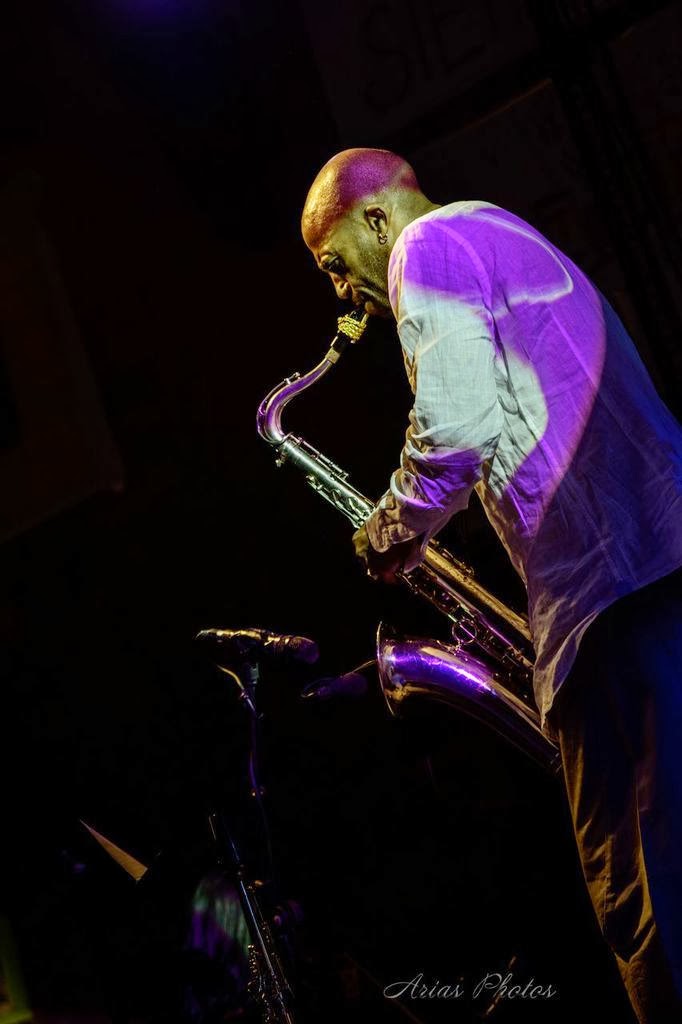
In Part 2 of this Black Paris Profile on Leonardo ("Nardy") Castellini, Nardy discusses the places that he's lived in Europe, his feelings for his homeland, and his life in Paris.

************


Nardy Castellini
© Ariel Arias

ETBP: You have lived in Denmark and Spain. Tell us how you came to reside in these two countries, where you lived in each country, and how long you lived there.

NC: I moved to Denmark with a close friend, a trumpet player, who offered me the opportunity to play with the Danish Radio´s Orchestra and a Cuban-Spanish-Danish project called Son en Talla. I lived in Copenhagen for two years. Then I started playing and touring around the world with Cubanismo Orchestra and I moved to Granada Spain, where I lived for more than 15 years. I developed my own musical project and also formed and shared the leadership of a few different styles of musical projects, such as the Granada Blues Band, Four Runners with Dario Moreno, and Domestic Jazz Collective with DJ Toner, amongst others.

ETBP: What did you like and dislike about life in these countries?

NC: Each of the places where I lived offered me opportunities to play music, to collaborate with amazing musicians, and to meet many interesting people. As long as I can play, it means the environment around me is open to music and creativity, which means I am going to be happy. My life is my music so I can easily adapt anywhere and find sources of inspiration and energy every day.

In Denmark for instance, the local jazz scene is incredible and the local musicians are really excellent. A few weeks ago, I went to the “Maison du Denmark” in Paris for a jazz festival and it was a fantastic atmosphere and excellent music. I would love to collaborate again with Danish musicians. I have been very impressed by the lifestyle in Scandinavia—it is a very modern society in my view.

In my years in Spain I spent a lot of time traveling around the world touring with Cubanismo, Klimax and others. From Spain I really got a taste of the world from Thaiti (Tahiti) to Hong Kong, from Mexico to Montreal. I hate airports, because as you can imagine in today’s world traveling with a saxophone is a major challenge, but I love exploring as soon as I touch the ground.

ETBP: How does life in France compare to life in Denmark? In Spain?

NC: It is interesting to try to compare life in different countries. I think in the end of the day you are the same person anywhere you go and you bring in your suitcase your bad and your good habits. You miss things from a country but you compensate with something else you discover and start to like in another country. I probably kept habits that make me who I am in each one of these countries. I have been drinking liters of green tea in the morning anywhere in the world… For instance, my relationship to time is still very Spanish. I cannot have lunch before 2 or 3pm even in Paris, which can be complicated sometimes. I tell people we can meet in the afternoon and I mean 6 or 7pm which for them is early evening.

But to answer better on France, I should say there is so much I love here, starting with food and wine. I love cooking and going to the food market in France is incredible. I love the elegance in France, the sophistication. I am not a great fan of watching the news and keeping constantly up to date with the daily political and economical news. I think it helps me keeping my sanity. It is not that I do not care, but I feel I can have no impact. My only impact is to keep my energy to play well to make people happy in concerts and eventually help them change their mindset for a few hours.

ETBP: How often do you return to Cuba?

NC: Cuba is in my heart, and every time I play and share my music I bring people to Cuba. On the 7th of December I play in Geneva, Switzerland. They organized an entire day around Cuban culture and music and I am playing in the evening. Through a Cuban taste of cigars and rum, through images and sound, we will make people travel. Otherwise I still have my parents in Cuba and I miss them very much. I return as often as I can.

Cuba's Flag

ETBP: Is there a Cuban community in Paris?

NC: Yes, there is a large Cuban community in Paris that started many years ago. I know that the Cuban migration to Paris started around the middle of the XIX century. You can see many Cuban bars and restaurants and there are many Cuban artists. For instance I work with an amazing Cuban photographer, Ariel Arias, who took the picture attached to this article. Ariel is a great friend but above all I have a lot of respect for his artistic work. His pictures reflect deep emotions and I think that you can almost hear my music when you see his pictures.

ETBP: If so, are there places that the community socializes regularly? Places where they eat?

NC: Personally I do not know of specific places where the Cuban community meets, but I know a few well known Cuban restaurants: La Havanita Café (rue de Lappe), Cubana Café (rue Vavin), Ile Changó (rue Fontaine au Roi).

ETBP: What is your favorite leisure activity?

NC: Listening to music is certainly at the heart of my life, when I walk in the street, in the metro, at home, everywhere!

I love going to movies and in Paris it is so easy and there are so many opportunities to just stop in a movie theater. I go to a great cine club called the Pop Corn Club. These people are great! They organize evenings with old movies on specific themes and they invite cinema experts to talk about the movies. But it is also a great social club where people share drinks, food and music at the end of the movie. Paris is amazing for that.

I also like to go to photography exhibitions. Recently I discovered a great gallery and art center called Le Bal near place de Clichy. I love places that mix art with food and drinks to create a real feeling of a community meeting there. Otherwise, as I said before, I love cooking for my friends.

ETBP: What is your favorite neighborhood in Paris?

NC: All Paris is my favorite, but one of the most interesting neighborhoods is the 18th arrondissement. I love the amazing diversity of cultures, peoples and art there. From the traditional Montmartre, to rue des Abbesses, all the way to rue des Martyrs, I love the cafés where you sit outside even in the winter. It is so Paris for me.

I can take walks for hours in Paris and never get bored. I always raise my eyes to look at a façade, or a window. I also like the more modern architecture like the green tube of the Austerlitz Fashion Museum—that place near the river is so cool. I also discovered the flea market in Saint-Ouen on a Sunday morning and thought the place was absolutely unique.

In the end when you get to know Paris well, you discover that it is a collection of villages with their own identity and style. That is what makes Paris so rich.

ETBP: What advice would you give to someone who is thinking of moving to Paris?

NC: Don´t think about it, just do it!!

It is a very challenging environment, especially in arts, because a lot of very talented artists live here. But it gives you energy to show what you can do. Especially in jazz…

Paris has been historically a major hub for jazz musicians. Many of them, starting with Miles Davis, fell in love with Paris and were always sad to leave. Maybe it is the romantic side of Paris, which I know is not the only reality. But Paris touches you deeply and makes you feel you need that special atmosphere that cannot be compared. Even if I love New York and its energy and London and its free creative vibes, Paris has something maybe close to melancholy that makes it special, at least for me. Paris is very jazzy.

A last point I want to make is that in Paris I met amazingly innovative people who are supporting music in a new way. For instance, I became recently a Bandsquare artist. Bandsquare is a crowd funding platform that supports musicians to play live music. We know crowd funding as a means to finance recording of CDs, but Bandsquare is about live music. It’s totally new. The platform was launched in October 2013 by Chloe, a young brilliant entrepreneur who deserves a lot of credit.

As you can see France has a big potential for innovation in the culture market and I want to be part of it!

Le Petit Journal Montparnasse
© Discover Paris!

Nardy will perform on December 17, 2013 at 9:30 PM at:
Le Petit Journal Montparnasse
13 rue du Commandant Mouchotte
75014 PARIS
Telephone: 01 43 21 56 70
E-mail: infos@petitjournalmontparnasse.com

Dinner and concert: 60 euros
Concert plus one drink: 20 euros

For Part 1 of Nardy's Black Paris Profile, click here.

************


Entrée to Black Paris!™ is a Discover Paris! blog.

If you like this posting, share it with your friends by using one of the social media links below!

Thursday, December 5, 2013

Black Paris Profiles™ II: Nardy Castellini - Part 1

I learned about Leonardo ("Nardy") Castellini several weeks ago when I received an e-mail message from "Berry," a woman who supports jazz musicians by promoting their work. Her passion for Nardy's music inspired me to delve into his story, which I found to be fascinating! I am pleased to share it with you on the blog. Here's Part 1.

************


Nardy Castellini
© Ariel Arias

ETBP: You were born in Matanzas, Cuba and were influenced by jazz from an early age. You left engineering school to devote yourself to studying the saxophone. Did music other than jazz interest you at that time?

NC: Of course I grew up with all kind of music influences. In Cuba, music is everywhere. Since the age of five, I sang at home with my father. He was an engineer but was passionate about music and played the guitar.

My father was playing what we call the “feeling” style, which is a Cuban way to interpret songs like boleros with very nice lyrics. This style is very close to jazz and certainly influenced me. However, I have been also influenced by soul music, rhythm and blues, and funk.

ETBP: Were you interested in the origins (history and precursor music) of jazz or simply the
sounds of the music itself?

NC: At the beginning, I was mainly touched by the music itself. Later I started to explore the history of jazz, the biographies of the legends like Bird or Miles. It is important to place the origins of jazz in their socioeconomic and cultural context.

ETBP: You state that after touring the world with various groups, you felt the call to go beyond your Cuban roots into a personal quest of your identity and your origins. Please elaborate on this – do you mean your musical roots, your family tree …?

NC: My musical roots cannot be separate from my family tree. My music is about me and my life is driven by my music, so you cannot separate the two.

When I started to work on my first album, I felt I was ready to share my own compositions with musicians for whom I had great admiration and invited them to record with me. Identity is based on Afro-Cuban and Yoruba rhythms, which reflect my personal identity. Identity is also constructed around the language of jazz, or improvisation, which is my musical identity.

That is the reason I invited Sherman Irby, saxophonist from New York and one of the alto sax references in be-bop and hard-bop music to join the band on the recording. I also invited Tata Guínes. His unique way of playing tumbadoras (congas), his sound and the rhythm is so special—for me, he was the master of Afro-cuban percussions. Finally I invited Omar Sosa, who in my view is one of the most innovative Cuban musicians. He has a very unique way of improvising and interpreting Cuban and Afro-cuban music. All these elements reveal the essence of the new and contemporary sound in the album.

ETBP: In what year did you begin this search? How long did it take for the answers that you sought to appear in your music?

NC: I think it just happened organically. I did not decide one day but it has been like a maturation process. When I was on tour with bands in the past I was certainly playing, but you also have a lot of travel and waiting time and I used it to work on my own approach to music. As a result when I started the process of working independently things came together in harmonious way rather quickly.

Origenes album cover

ETBP: What happened between 2002 (Identity) and 2010 (Origenes) to change your music?

NC: For many years I was touring with the Identity album, then I started a project with a Sudanese singer called RASHA, and we toured in Sudán and Egypt. After that, I started a project mixing my music with Nubians musicians, bringing this project to the Jazz Factory Festival in El Cairo, Egypt. My work with Nubians was totally fascinating and I wish one day I could go back to this project and bring them to play with me in Paris.

Traveling to new territories and experiencing new cultures was a major inspiration for Origenes. You find many more Oriental sounds in this recording. This project was going beyond my personal Cuban quest for identity to broader reflections on the origins of African rhythms—indeed, the origins of music considering that the Nubians are one of the most ancestral ethnic communities in the world.

ETBP: When did you move to Paris?

NC: I moved to Paris in late 2011.

ETBP: What influence has living here had on your music?

NC: I am working on the new album and the influences are diverse. Paris has such an esthetic perfection that you can find beauty anywhere. You can find art, creativity, innovation, tradition, poverty, and luxury—many contradictions that reflect today’s world. I play with new musicians, I met new friends, and I get a lot of stimulation in Paris which might lead to an unexpected new album.

ETBP: You say that you play with Cuban musicians, but “not only.” Where do the “other” musicians come from?

NC: For instance, in my last album, Origenes, you can find Spanish, Sudanese, and Moroccan musicians. This year I also collaborated with French, Venezuelan, Greek, British, and Swiss musicians. Jazz is universal and I am really interested in the jazz culture in countries such as India, for instance.

ETBP: Do you select them solely because of their talent or are you looking for them to bring elements of other styles of music to your group?

NC: Often talent brings new concepts, new ideas, different feelings, and different ways of expressing the music that contribute to the richness of the music. I am also looking for good energy and conceptual connection with my music. Finally, I am looking for people who can play well together as a band. Collaboration, respect, friendship are also human values that are very important for me.

ETBP: What is your favorite place in the world to play?

NC: Well first I should say, my favorite place to play is place where I can play. I need to play as often as possible. It is my “raison d’être” and wherever it is I am always feeling alive when I play.

I also would like to explore new places to play. Jazz should not be limited to jazz clubs—we can bring jazz to museums, to universities, and to enterprises. We should be more creative in the way we give access to jazz to more people.

That being said, my favorite festival has been Montreal, my favorite theater has been Radio City Hall in New York, and for my favorite jazz club I would say Ronnie’s Scott in London. What makes a place special is its history, the way the staff cares about musicians, and the warm response of the audience.

ETBP: What is your favorite place in Paris to play?

NC: Paris has a very important and very diverse jazz scene. It is a complex, small world and I am still learning how to navigate this space. I go to play in many jam sessions to learn more about the Parisian jazz community. I am supported by great professionals like Michèle Feriaud at Batida and Co, who has been in that space for many years and helps me find my way around.

Le Petit Journal Montparnasse
© Discover Paris!

More specifically, I have to say that I have a lot of respect for the new team running the Petit Journal Montparnasse. This place is historical and is now going through a “rebirth,” which is exciting. Melanie, the person in charge of programming for the Club, is very nice and welcoming. I am really looking forward to playing there for the first time on the 17th of December.


Nardy will perform on December 17, 2013 at 9:30 PM at:
Le Petit Journal Montparnasse
13 rue du Commandant Mouchotte
75014 PARIS
Telephone: 01 43 21 56 70
E-mail: infos@petitjournalmontparnasse.com

Dinner and concert: 60 euros
Concert plus one drink: 20 euros

To read Part 2 of this interview, click here.

************


Entrée to Black Paris!™ is a Discover Paris! blog.

If you like this posting, share it with your friends by using one of the social media links below!

Thursday, February 10, 2011

Art and Food Pairing™: Galerie Intemporel and O Corcovado Restaurant

Go Gourmet with Discover Paris! We can show you the best of the city’s pastry and chocolate shops, arrange a private wine hop, organize a dinner in an authentic Parisian home prepared by a private chef, help you plan your Paris picnic…

To learn more, visit our gourmet itinerary page at www.discoverparis.net/gourmet.html or send a message to info[at]discoverparis[dot]net. Click here to access our free Paris Insights restaurant reviews!

************

Several months ago, I was contemplating my never-ending quest to increase my food and wine pairing skills when the idea sprang to mind that I could pair art and food in a similar fashion. I had been exploring museums and galleries that display African or black Diaspora works, and wanted to couple the visual experience at these venues with a gustatory experience at a nearby café or restaurant. Thus, the concept of Art and Food Pairing™was born!

Today, I present the vibrant exhibition Acqua at the Galerie Intemporel (http://www.galerieintemporel.com/) coupled with a dining experience at O Corcovado in the Marais.

Galerie Intemporel was founded by Laurence Choko in 1998. It is located in the heart of the Marais, only a few blocks from the Pompidou Center. The gallery’s mission is to expose modern and contemporary works of select artists of the African Diaspora and other countries.


Choko is particularly supportive of artists from Cuba. The Galerie Intemporel Web site lists no fewer than eleven Cuban artists, most of whom are painters. But Choko shows works from artists from other nations as well, including her native Martinique, Haiti, Chile, the Dominican Republic, Iceland, and Australia. She also shows works by U.S. photographer Frank Stewart at the gallery.

During the 2010 Art Basel Miami Beach show, Choko opened a temporary gallery where she presented sculpture by Barbara Chase-Riboud and a portrait by Beauford Delaney alongside the works of many of the artists that she normally supports. She eventually plans to show selected works by these American artists in the Paris gallery.

The exposition Acqua features the paintings and sculpture of Cuban artist Arturo Montoto. Most of the works are paintings – aquarelle still lifes to be exact. Having grown up on a farm on the outskirts of Pinar del Río city, Montoto developed a passion for fruit, and most of the works shown at Intemporel depict them in exquisite color and form. Curator Choko has chosen a couple of powerful, bronze sculptures that feature fruits for the exposition as well.

Painting: Oro Caribe (2009) Oil on canvas
Screenshot from Galerie Intemporel Web site

Montoto was born in 1953. He graduated from the National School of Art in Havana, and went on to earn a Master of Fine Arts degree at the State Institute V. I. Súrikov in Moscow, with a specialty in mural painting.

Click here to see the entire Montoto collection shown at the exposition.

Once your appetite is whetted by Montoto’s uncannily realistic portrayals of food items, take a five minute walk to the restaurant O Corocovado Beaubourg, one of two sister restaurants serving authentic Brazilian cuisine in the City of Light. (The other restaurant is located in Montparnasse.) You cannot fail to find this eatery on the short and barren rue Simon le Franc, only steps away from the Centre Georges Pompidou, because the arched entry is marked by a neon sign in the yellow and green colors of Brazil.

O Corcovado Entrance
© Discover Paris!

Walking into the restaurant, diners are immediately immersed in atmosphere. Samba, bossa nova, and other forms of Brazilian music play on the sound system. The bar and the walls are brightly colored, and a chandelier with multicolored lights boasts an artificial macaw on a perch. Paintings of Brazilian street scenes grace the walls amid kitschy decor. The restaurant prepares the non-alcoholic portion of its signature cocktail – the caipirinha – in advance, so that the bar is often lined with glasses containing sugared lime juice and wedges of lime. This makes it easier for the bartender to fulfill orders quickly by adding ice and Cachaça, a potent Brazilian liquor made from fermented sugarcane juice, and shaking vigorously to mix the ingredients. My partner and I each ordered one, and found the drinks to be fruity and refreshing. Our server assured us that the Vitamin C from the lime juice and wedges would fortify us against colds and flu!

The servers speak Portuguese amongst themselves, and several Portuguese speakers were among the diners the night that we ate there. Though the names of all dishes are presented in Portuguese, explanations are presented in French. English is spoken as well. Servings are copious, so be forewarned.

My partner and I elected to order a full, three-course meal. As an entrée, I had the six “petit-fours” – two were stuffed with beef, two with chicken, and two with cheese. These were actually crispy, crunchy fritters with a thick, lightly seasoned, bread-like crust. They were served with a sweet and sour sauce and minced onions. While they were quite tasty, they were so large that I feared I would not be able to finish my main course! My partner selected the crabe farci, which was a misnomer because the dish was not served in a crab shell, but rather, in a porcelain serving dish. However, this did not change the fact that he found it to be completely satisfying.

Feijoada
© Discover Paris!

For the main course, I chose the national dish of Brazil – feijoada. O Corcovado’s rendition is made from black beans, pork sausage, and beef morsels and ladled around a mound of white rice in the center of an enormous plate. Slightly steamed “new cabbage” and diced oranges are served alongside. This is a terrific meal to order on a cold day, as it is stick-to-the-ribs delectable! My partner chose the Xinxim de Galinha, two large chicken thighs stewed in a sauce made of peanuts, cashews, shrimp, and garlic. This was served with a side of white rice. He thoroughly enjoyed it, and I vowed to try it next time because the portion is more appropriately sized for me.

Xinxim de Galinha
© Discover Paris!

My partner ordered a blond Brazilian beer called Brahma to accompany his meal, while I remained faithful to the caipirinha.

Dessert consisted of a Pudim for my partner and a Quindim for me. Pudim is Brazilian flan topped with caramel sauce, and Quindim is dense coconut custard atop a cookie-like crust. Both desserts hit their mark, being pleasingly sweet but not too filling.

Galerie Intemporel
37, rue Quincampoix
75004 Paris
Telephone: 01.44.59.63.29
Metro: Châtelet
Hours: Tuesday through Saturday 2 PM to 7 PM, or by appointment

O Corcovado
7, rue Simon le Franc
75004 Paris
Telephone: 01.42.71.52.07
Metro: Rambuteau (Line 11)
Hours: Monday through Sunday 7 PM to 1 AM (food service ends at 11 PM)

************


Entrée to Black Paris!™ is a Discover Paris! blog.