Showing posts with label Cameroon. Show all posts

Thursday, October 23, 2014

Cap 99 - Afro-Caribbean food in the Quartier Mouffetard

Sunday was a picture perfect day in Paris and Tom and I decided to cap off a photography session on Pont Alexandre III and the Tuileries Garden with dinner at a neighborhood restaurant that we've walked by many times - Cap 99 on rue du Pot de Fer in the 5th arrondissement. The restaurant is less than half a block from rue Mouffetard, our favorite market street.

Cap 99 Façade
© Discover Paris!

Eric is the proprietor of Cap 99. He is from Benin and is quite the convivial host. When he saw that we wanted to take photos of the dining room, he pulled out a drum and posed for us!

Cap 99 dining room
© Discover Paris!

Eric poses for us
© Discover Paris!

The cuisine at Cap 99 is primarily West African. Traditional dishes such as Ndole, Yassa, and Mafé are accompanied by missolé (plantains) and Cameroonian beers are listed on the beverage menu. The French Caribbean gets a nod with Accras and Colombo...

Eric makes fabulous jus de gingembre (ginger juice) that he "spiked" with morsels of dried ginger for me. (I thought the juice was potent until I tasted these little nuggets!) He sold his last Cameroonian Guinness before we arrived so he offered Tom a Mützig (another beer brewed in Cameroon - made with barley, corn, and hops) that was three times the volume of the Guinness - for the same price. So we were set for beverages for this amazing meal.

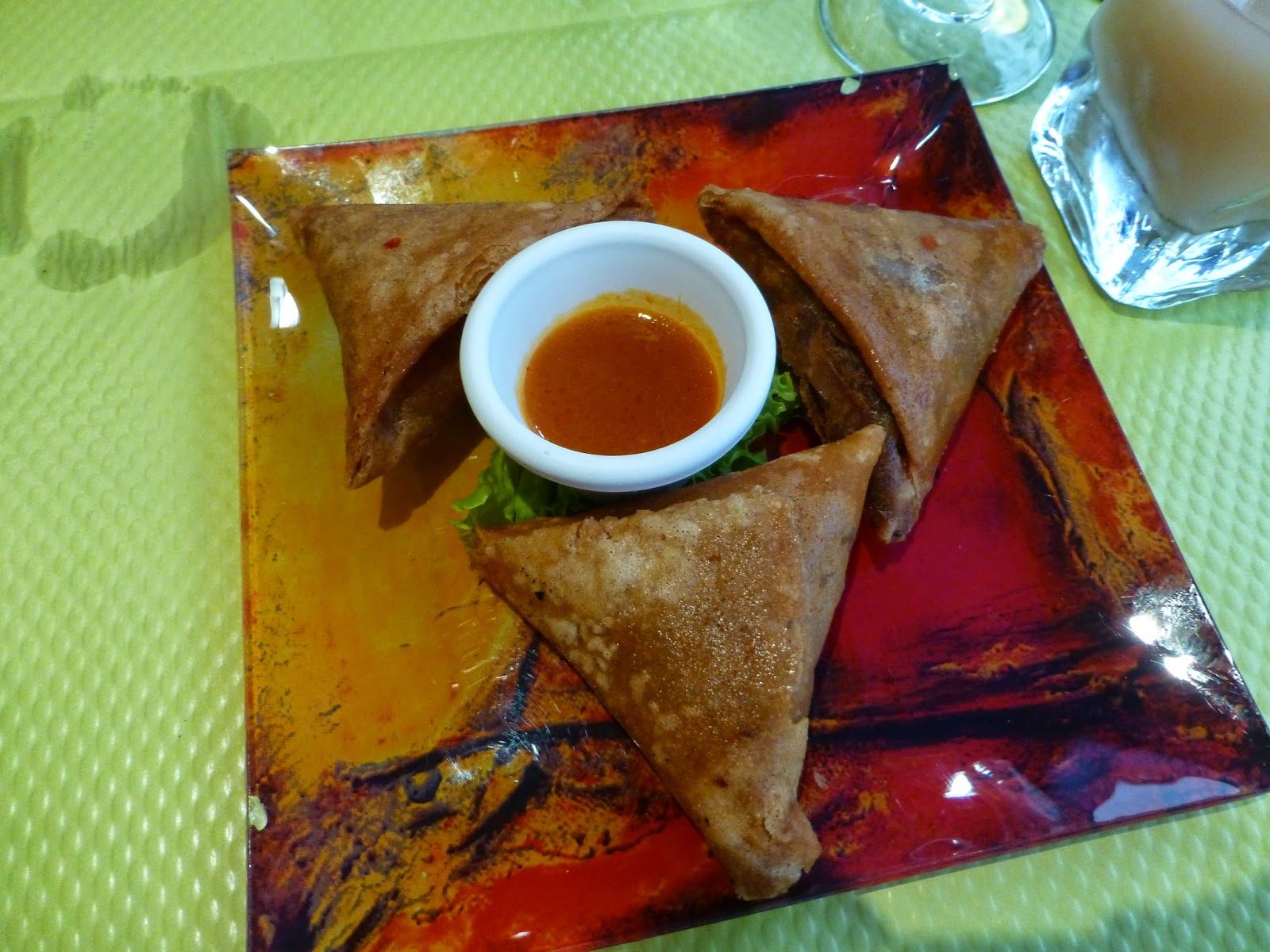
We were so hungry after our photo shoot that we forgot our cardinal rule - never order three courses at an African restaurant because the portions are so large that you either overeat or can't finish your meal. I ordered Samoussa de chasseur followed by Yassa poulet for the main course and Blanc manger coco for dessert. Tom ordered Accras de morue followed by braised tilapia for the main course and Mont Mandara (named after a Cameroonian mountain range) for dessert. And sure enough, we left feeling stuffed because we tried to eat everything that Eric set before us!

The samoussas, three triangles of brick pastry stuffed with minced beef, green peas, diced potatoes, and minced carrot, were large enough to have served as my main dish. Piping hot, they were accompanied by a tomato-based sauce flavored with dried shrimp and ginger. They were absolutely scrumptious!

Samoussa de chasseur
© Discover Paris!

The yassa was prepared with loads of onion and pitted green olives. A large mound of white rice and five generous slices of caramelized plantain were served alongside a large chicken leg and back. I couldn't even fathom eating the rice!

Tom loved his accras and he eagerly sampled one of my samoussas as well. When his tilapia arrived, he was overwhelmed! An entire fish - plus rice and missolé - covered his plate, which was larger than mine. He devoured it with gusto.

Tilapia
© Discover Paris!

Eric saw that he finished his plantains and offered another serving of them, which Tom accepted. He made a valiant attempt to finish his rice with the spicy onion condiment served with the tilapia, but he could only manage to eat half of it. He wanted to save room for dessert, as did I.

My Blanc manger coco was a coconut pudding made with condensed milk, coconut milk, coconut flakes, and a coconut wafer on top. Tom's dessert was a portion of warm chocolate cake with a molten chocolate center sitting in crème anglaise and topped with coconut ice cream.
Mont Mandara
© Discover Paris!

After finishing this course, we both pushed away from the table feeling that we needed an after-dinner nap!

Cap 99
5, rue du Pot de Fer
75005 Paris
Tel: 09.51.65.94.56
Metro: Place Monge (Line 7)

Thursday, April 10, 2014

Rio Dos Camarãos Restaurant: A Review


Rio Dos Camarãos is an African restaurant located in the eastern suburb of Montreuil, about a five-minute walk from the metro station Robespierre. Tom and I first learned about it when we were surfing the Internet for restaurants serving Afro-centric cuisine. We found an intriguing photo of a banana-chocolate tart presented on a place mat made of bottle caps and followed the information trail to this spacious eatery.

Rio Dos Camarãos - façade
© Discover Paris!

When we saw the African statuettes in the window, we knew that we had arrived.

African statuettes
© Discover Paris!

The interior is simply decorated but the elements that chef and owner Alessandro Bella Ola and his wife have chosen to embellish the large dining room are unmistakably African. Handsome cloths cover the tables and large and small dolls dressed in colorful cloth are placed throughout the restaurant. Color photographs of Africans hang on the walls.

Table setting
© Discover Paris!

Dolls and wine rack
© Discover Paris!

Our waiter, whom we later learned was Chef Bella Ola, invited us to take a table. There, we studied the menu that listed a wide range of traditional African dishes, including Mafé, Ndolé, and Yassa.

We decided to order apéritifs while pondering what to order. Tom chose a blond beer from Cameroon called Castel. Served in a 65cl bottle, it was refreshing with a slight bitter taste. I ordered a Punch au bissap - a cocktail of rum and hibiscus juice. While suitably bracing due to the rum, I found that the flavor of hibiscus was not as strong as I expected (or would have liked). I felt the same about the non-alcoholic ginger juice that I ordered to accompany my meal.

Chef Bella Ola brought over a dish of spicy peanuts and corn nuts to accompany our beverages. Tom also ordered a small side dish of green banana chips, which really did taste like green (slightly unripe) banana. These were fun to crunch on.

After Chef Bella Ola served the beverages, he disappeared into the kitchen. A woman, whom we later learned was his wife, took over the table service.

We are always wary of ordering too much food at African restaurants, so when I spied an intriguing starter called Nyam ngond on the menu, I asked Chef whether it was copious. He assured us that we would receive a "truly appetizer-sized" portion, so we decided to order it. Chef graciously invited us to split it between us so that we'd be sure to have enough room for the main dish.

Nyam ngond
© Discover Paris!

Nyam ngond is a cake-like preparation of pumpkin seeds. It was presented as a flat disk resting on a mound of julienned carrot, zucchini, and cabbage. Instead of containing crunchy morsels of seeds, it was spongy and it had a flavor slightly reminiscent of fish broth. We later learned that it is a dish that is generally served as a main course on the day after family celebrations. We found the salad to be quite refreshing.

We both had a difficult time deciding which main course to choose from the wide variety on the menu. Tom finally settled on Mafé poulet fumé, otherwise known as smoked chicken in peanut sauce. This turned out to be an excellent choice. Madame Bella Ola brought a dish containing a mound of fluffy, white rice and a steaming cast-iron pot containing chicken with carrot and cabbage smothered in peanut sauce. The chicken was tender, the vegetables flavorful, and the rich sauce tempting. Simply delicious!

Mafé Poulet Fumé
© Discover Paris!

I decided to try the national dish of Cameroon, called Poulet D. G. I received a sizzling-hot iron plate containing a copious portion of stewed chicken legs, plantains, leeks, and red and green bell peppers. The chicken was tender and juicy and the plantains were just sweet enough to add balance to the spices in the dish. The vegetables added color and texture to this heavenly preparation.

Poulet D. G.
© Discover Paris!

The dessert menu offered some unusual choices. Tom opted for Tatin banane, a large slice of caramelized, upside-down banana pie served with two dollops of whipped cream. It was fashioned after the traditional Tarte des Demoiselles Tatin that is made with apples. The bananas were dense and chewy and tasted somewhat like the sun-dried bananas that one sometimes finds at specialty stores. Tom loved this, declaring that he could eat a slice every day!

Tatin banane
© Discover Paris!

I sprang for Crème brulée au citron vert. It looked like a traditional crème brulée with its burnt-sugar crust, but it had the bright pick-me-up flavor of lime rather than the mellow-me-down flavor of vanilla. I quite enjoyed it.

Chef Bella Ola, who hails from Cameroon, honored our request to come out from the kitchen at the end of our meal to pose for a photograph.

Chef Alexandre Bella Ola
© Discover Paris!

He proudly shared that Rio Dos Camarãos restaurant will celebrate twenty years of existence in November 2014. He is planning an entire remake of the menu at that time. We're looking forward to returning in the fall so that we can sample his new culinary creations!

Rio Dos Camarãos
55, rue Marceau
93100 Montreuil
Tel.: 01.42.87.34.84
Métro station: Robespierre (Line 9)

************


Entrée to Black Paris!™ is a Discover Paris! blog.

If you like this posting, share it with your friends by using one of the social media links below!

Thursday, March 27, 2014

Cameroonian Fashion Designer Is Featured on Canal Boat Cruise

The tourist bureau of Seine Saint-Denis, a French administrative department that lies just north of Paris, is actively promoting the numerous artists, musicians, and designers that live and work there. Last Saturday, it focused on two exceptionally creative designers who work with textiles - Andreéa Talpeanu and Lamyne M. - during a fun-filled boat cruise on the Canal Saint-Denis and the Canal de l'Ourcq.

Embarking for Fashion Cruise on Canal Saint-Denis
© Discover Paris!

While the boat cruised slowly along the canals, attendees were able to enjoy the scenery and learn about the history and architecture of the area thanks to commentary provided by photographer, architect, and historian Patrick Bezzolato.

Full House
© Discover Paris!

Patrick Bezzolato
© Discover Paris!

Andreéa Talpeanu is an artist of Romanian origin who creates sculpture from textiles. She performed in a thought-provoking one-woman show during which she seized and ripped items of clothing that she had distributed to the audience. Her goal was to raise awareness of the poor quality of many fabrics that are manufactured today and the waste that the use of these fabrics engenders.

Andreéa Talpeanu
© Discover Paris!

Lamyne M. and his fashions were the main attraction of the event. Lamyne hails from Cameroon, where he began his training as a tailor at the age of 13. Like Ms. Talpeanu, he is particularly mindful of the origin and quality of the fabrics that he uses to create his designs. He constructs fine garments with remnants recuperated from bolts of cloth used by design houses such as Yves Saint Laurent and Smalto to construct the finest garments. He also experiments with new, environmentally-friendly materials—such as fabrics made from cactus fiber. His design house is called Wonu An, which means "Be yourself" in Fula (a language of West Africa).

Wonu An Designs Worn Presented the Cruise
© Discover Paris!

Lamyne specializes in men's fashions, though he designs for women as well. All of his garments are hand-sewn by craftsmen in workshops in Morocco and Cameroon. During his presentation, he proudly announced that hip-hop recording artist Kanye West has purchased his designs.

Lamyne M.
© Discover Paris!

Lamyne is collaborating on a fascinating project with Professor Maya Thebault and students from La Source, a vocational high school in the town of Nogent that trains textile professionals. Together, they are to crafting "Giant Robes" three meters (9.8 feet) tall that are based on the designs of gowns worn by French queens and princesses of medieval times. The recumbent statues of these women are found at the royal necropolis of the Saint-Denis Basilica.

The students have been making careful drawings of the gowns in which the women are dressed. They have selected Holland Wax print fabrics, typical of those used for contemporary African fashions, to create the robes and accompanying accessories.

Professor Maya Thebault and Students Displaying Drawings of Giant Robes
© Discover Paris!

Mock-up of Giant Robe
© Discover Paris!

Photo of Accessory for Giant Robe
© Discover Paris!

The giant dresses will be shown in an exceptional exposition at Saint-Denis Basilica in 2015.

Instead of selecting professional models to present his fashions during the cruise, Lamyne chose everyday people from the town of Saint-Denis.

He also invited the audience to participate in the show. Two persons volunteered. This young woman...

Volunteer Model from Audience
© Discover Paris!

...and me!

Monique Modeling a Wonu An Blazer
© Discover Paris!

Lamyne's workshop is located at 9, rue Moreau in Saint-Denis.

Lamyne Takes a Bow
© Discover Paris!

For more information about Saint-Denis tourism, visit http://www.tourisme93.com (site in French).


************


Entrée to Black Paris!™ is a Discover Paris! blog.

If you like this posting, share it with your friends by using one of the social media links below!

Thursday, May 23, 2013

A Little Bit of Africa at Fair Trade Show


Last Sunday, Tom and I visited the Paris suburb of Alfortville to attend the last day of the 13th edition of the Journées du Commerce Equitable (Fair Trade Days) at the Mairie (town hall). Alfortville is proud to have won the title of "Fair Trade Territory" in 2009 and 2012, and is committed to raising awareness of the importance of responsible and socially-conscious commerce.

Trade show banner
© Discover Paris!

We partook of a light "brunch" of products donated by Artisans du Monde, including honey, jams, chocolates, and fruit juices, then took a tour of the many stands that bordered the square in front of the town hall. We enjoyed a mini-concert by the group PARADISE, which regaled participants with Antillean music,


PARADISE
© Discover Paris!

and then visited three stands that were of particular interest. The first was for AKAME, an association that promotes products made from Cameroonian cloth.


AKAME
© Discover Paris!

The next was ARTOK PARIS. This group, along with several others in Paris and the surrounding suburbs, supports the Humaine Promotion of Tokombéré Project. Tokombéré is a town and commune in northern Cameroon. The women of this area create fine baskets, pocketbooks, tablecloths, and other items. Two French women were selling these products at the fair.


ARTOK-PARIS
© Discover Paris!

Finally, we stopped by the stand for BAŠTINA VOYAGES, an organization that promotes equitable tourism. We met Stefan Buljat, president of the organization, several weeks ago on a walking tour of the Château Rouge quarter of the 18th arrondissement called "Petit Mali" ("Little Mali"). Baština's mission is to encourage the French to travel to countries such as Mali, Senegal, Georgia (former USSR), and Croatia by introducing them to a slice of culture from the destination country before they ever leave Paris.

Stefan Buljat, president of Baština Voyages
© Discover Paris!

In keeping with its mission, Baština is participating in Paris Ville Monde, which is being billed as "a month to tour the world in Paris." Beginning on May 31st with the Bal de l'Afrique Enchantée (Enchanted Africa Ball), the event runs through June 30th. For more information, visit www.paris-ville-monde.com.

************


Entrée to Black Paris!™ is a Discover Paris! blog.


If you like this posting, share it with your friends by using one of the social media links below!


Thursday, December 15, 2011

France's African Face in Bobigny

Bobigny's Marianne
© Discover Paris!


The town of Bobigny, which borders Paris to the northeast, is the préfecture (capital) of the department Seine-Saint-Denis. According to Jean-Jacques Brilland, director of the Bobigny tourist office, the identity of the city is based on three concepts:

Ville Monde – A city of the world, Bobigny is proud of its diverse population (over 100 ethnicities at present).

Ville Coeur – Bobigny, the heart of Seine-Saint-Denis, is a city of social solidarity.

Ville par Tous, pour Tous – A city by everyone, for everyone, Bobigny calls upon its citizens to speak up and be heard, always keeping the common good in mind.

The ultimate expression of this inclusiveness can be found in the Salle des Mariages (marriage hall) at the Hôtel de Ville (City Hall). Entirely decorated by artist Hervé Di Rosa, founder of the art modeste movement, it is a testimony to the principle of direct democracy – the decisions regarding the reconstruction and decoration of the room were made after direct consultation with the citizens of the city. The elements that make up the room bear witness to the incredible diversity that has defined Bobigny since the 19th century.

Salle des Mariages at Bobigny
© Discover Paris!

The hearts that lovers carve on trees inspired Di Rosa to design the heart-shaped seats for the room. He created special chairs for the bride and groom, complete with men’s and women’s shoes for the legs. The backs are decorated with smiling faces. The top of the bride’s chair is crowned with a wire heart, representing the French expression coup de coeur, and the groom’s chair is topped by lightning bolts, representing the French expression coup de foudre. Both translate into English as “lovestruck.”

A second pair of these chairs is available to accommodate celebrations for same-sex couples. The chairs were created in Miami, where the artist had a studio for a period of time.

The most remarkable work in the room is Di Rosa’s sculpture of La Marianne, an emblem of France that has been used to represent the spirit of the Republic since the late 18th century. Although she has traditionally been depicted as a white woman, Di Rosa chose to represent Marianne as an African figure. Indeed, he engaged masters of the lost wax-casting technique in the town of Foumban, Cameroon to create the sculpture.

Bobigny's Marianne has the breasts and protruding belly (representing prosperity and generosity) that are characteristic of African statuary of women. She has Negroid facial features and Di Rosa's signature touch of two sets of eyes – one that gazes down upon the happy couple at the moment of their marriage, the other off into the distance, symbolizing eternity – the ideal length of the couple’s union. Marianne does wear the traditional Phrygien bonnet, which in this case represents the freedom of French-owned slaves at the time of the Revolution.

Marianne de Foumban
© Discover Paris!

The sculpture is nestled in a niche that is painted white and intentionally located between a long blue wall to the left and a long red wall to the right. Together, the colors represent Le Tricolore (the French flag). When the bride and groom stand up to take their vows, they stand before the mayor's table (heart-shaped; designed by Di Rosa), the flag, and Marianne.

Why an African Marianne? Di Rosa responds to this question as follows:

It is not written anywhere that Marianne is blond with blue eyes! For me, Marianne is love, the world, the Republic - so why not an African?

Di Rosa also acknowledged the pervasion of American-style hip-hop graffiti in Bobigny by installing several floor-to-ceiling panels decorated in this art form. One panel displays the Chinese hieroglyphic that represents love and another bears the word boboche, a term of affection for the city. These works created by four artists, three of whom are local residents.


Graffiti in the Salle des Mariages
© Discover Paris!

At the end of the marriage ceremony, the bride and groom select one of six original, signed and numbered serigraphs to take home as a memento of their union. (Two of them are shown below.) The artists who contributed these works are Hervé Di Rosa (France), François Boisrond (France), Rachid Koraichi (Algeria), Ricardo Mosner (Argentina), William Wilson (France/Togo-Benin) et Maître Akeji (Japan).

Serigraphie
(2006) William Wilson
© Discover Paris!


Serigraphie
(2006) Ricardo Mosner
© Discover Paris!

The Salle des Mariages was inaugurated on May 12, 2006.

************


Entrée to Black Paris!™ is a Discover Paris! blog.

If you liked this article, share it with your friends and colleagues by clicking on one or more of the social media buttons below!