Showing posts with label Sorbonne. Show all posts

Thursday, March 30, 2017

Anna Julia Cooper - First African American to Earn a Ph. D. at the Sorbonne

As the end of Women's History Month rapidly approaches, I thought it would be fitting to write an article about a phenomenal woman who is a major figure in the history of African Americans in Paris. Her name is Anna Julia Cooper.
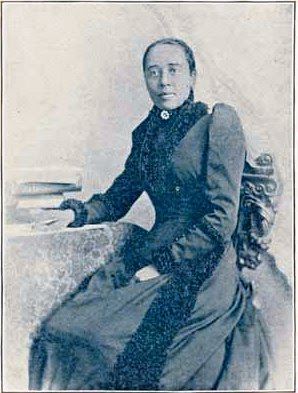
Anna Julia Cooper in 1892
Photo from A. J. Cooper's book The Voice of the South
Image in public domain

In an article published in Paris on April 28, 1925, the Chicago Tribune wrote the following about her:

Mrs. Cooper won her doctorat d'universite at the Sorbonne on March 23, 1925, and she left Paris for her native city of Washington, D.C. a month later.

The subject of her thesis at the Sorbonne was: L,Attitude [sic] de la France a l'egard de l'esclavage, 1789-1848*.


*The Attitude of France Toward Slavery during the French Revolution

Born in Raleigh, North Carolina in 1858, Cooper was the daughter of a white slaveholder and an enslaved mother. She was nine years old when she received a scholarship and began her education at Saint Augustine's Normal School and Collegiate Institute in Raleigh. An excellent student, she went on to earn a Bachelor's degree (1884) and a Master's degree (1887) at Oberlin College.

Cooper completed courses in French literature, history, and phonetics at La Guilde Internationale in Paris during the summers of 1911-1913 and enrolled in a doctoral program at Columbia University in 1914. Her pursuit of this graduate degree was hindered by personal circumstances, but she successfully transferred her credits from Columbia and La Guilde Internationale to the Sorbonne in 1924.

Details of the story vary depending on the source consulted, but Cooper did complete her graduate work at the Sorbonne in 1925. The university shipped her diploma to the U.S. and she received it at a ceremony held at Howard University on December 29, 1925.

Anna Julia Cooper was a master educator, education administrator, writer, community activist, and advocate for women's rights. She was a lesser-known contemporary and peer of Ida Gibbs Hunt and Mary Church Terrell, both of whom also spent time in Paris.

Part of Cooper's legacy is represented by a commemorative U.S. a postage stamp:


and the inclusion of one of her quotes included at the top of pages 26 and 27 in the U.S. passport:

The cause of freedom is not the cause of a race or sect, a party or a class -
it is the cause of humankind, the very birthright of humanity.


Cooper died in Washington, D.C. in 1964 at the age of 105. She is buried in Raleigh, North Carolina.

************


Entrée to Black Paris!™ is a Discover Paris! blog.

If you like this posting, share it with your friends by using one of the social media links below!

Thursday, November 19, 2015

Dr. Bryan Carter's Digital Love Affair with Paris

Dr. Bryan Carter is an Associate Professor at the University of Arizona's Department of Africana Studies. With a strong background in both 20th-century African-American literature and digital technology, he teaches the history of the Harlem Renaissance and the techniques of emerging digital culture. He has collaborated with the University of Paris IV - Sorbonne for many years, bringing classrooms alive with his lectures on digital technology.

Dr. Bryan Carter at café Le Rostand, Paris
© Discover Paris!

In 2004, Dr. Carter was named Professeur Invité by the Sorbonne and asked to be the project leader for the development of a digital project called Virtual Montmartre. Since then, he has received the Professeur Invité award twelve (12) times. He has been bringing University of Arizona students to Paris for study abroad since 2013.

I met with Dr. Carter in Paris a few days ago at Le Rostand, a café near the Luxembourg Garden, to discuss the details of a collaboration between his department at the University of Arizona and the Wells International Foundation (WIF). We have envisioned an Augmented Reality project that will bring U of Az students to Paris to create a digital platform for paintings that will be shown at the February 2016 Beauford Delaney art exhibition at Columbia Global Centers | Europe at Reid Hall.

Nativity Scene
Beauford Delaney
(1961) Oil on canvas

The working title for the exhibition is Beauford Delaney and Paris: A Breathtaking Evolution. It will be presented from February 4-29, 2016.

Using custom software, students will take high resolution images of several of the paintings in the show and upload them to a digital platform. They will then shoot short video segments of a docent explaining some aspect of each painting or the story behind it, and overlay that video on the image of the painting. When a visitor to the exhibition downloads the app on to a mobile device, he or she will be able to stand in front of a painting, scan it, and watch the video on the device’s screen.

Audio overlays and links to Web sites are other possible augments that will be considered for this project. Augments will be done in English and French.

Dr. Carter also gives a ten-day course in Paris over Thanksgiving break during which University of Arizona students experience "on the ground" what they have learned during a semester course at the university called "When African Americans Came to Paris." During that week, the students also create a collaborative video and implement an Augmented Reality project.

During his current stint at the Sorbonne, Dr. Carter is teaching a business technologies and e-commerce course to international business students. Course participants are being exposed a variety of technologies and topics related to business communications, digital technologies and cloud-based applications.

For more information about Dr. Carter, click HERE.

************


Entrée to Black Paris!™ is a Discover Paris! blog.

Thursday, September 19, 2013

57th Anniversary of the 1st International Congress of Negro Writers and Artists

The First International Congress of Negro Writers and Artists convened at the Sorbonne on September 19, 1956 - 57 years ago today. I was reminded of the date because I recently purchased the complete proceedings of the event from Présence Africaine, the bookstore and publishing house that was responsible for organizing the conference.

Proceedings of the 1st International Congress of Negro Writers and Artists
© Discover Paris!

I frequently refer to James Baldwin's report of the proceedings when I take clients to the Sorbonne on my Black Paris after World War II walking tour. He wrote about the congress in his essay "Princes and Powers" and I have always wanted to read an independent source of information about the event. During a recent tour, I noted with delight that there was a book in the window at Présence Africaine (which is also a stop on the Black Paris after WWII tour) containing the proceedings and returned to purchase it at a later time.

Présence Africaine - current façade
© Discover Paris!

Roughly a third of the entries in the book are in English.  Topics range from the tonal structure of Yoruba poetry to a philosophical discussion of segregation and desegregation in the United States. Final resolutions of the congress are presented in French and English. There are also messages at the back of the book in French and English from persons who were unable to attend, including one from Josephine Baker (in French, signed with her married name "Bouillon"). But the presentation that interested me the most was that of Richard Wright. I had long been intrigued by Baldwin's sardonic commentary on it and was looking forward to reading it for myself.

Wright was the last person to give a formal presentation at the Congress and he felt awkward about what he had prepared because things that he learned during the course of the conference inspired a desire to modify his discourse. Because there was no time to do so, he decided to "correct" his paper as he presented it at the conference. Baldwin refers to this as Wright "exposing, in short, his conscience to the conference and asking help of them in his confusion."

Baldwin and Wright Collage*
© Discover Paris!

Wright did just that, saying "...midway in my text, when I start criticizing my own formulations, I hope you would understand what I am trying to do." He proceeds to question several of his own statements, such as thanking "Mr. White Man" for freeing the black, brown, and yellow peoples of the world from the "rot" of their irrational traditions and customs.

Prior to broaching the subject of his discomfort, Wright talked about the absence of women as organizers and presenters at the Congress. He said the following:

— I don't know how many of you have noticed it there have been no women functioning vitally and responsibly upon this platform helping to mold and mobilize our thoughts . . . When and if we hold another conference—and I hope we will—I hope there shall be an effective utilization of Negro womanhood in the world to help us mobilize and pool our forces . . . we cannot afford to ignore one half of our manpower, that is, the force of women and their active collaboration. Black men will not be free until their women are free.

Indeed, among the messages at the back of the book is one addressed to the Congress by "Un Groupe de Femmes Noires" (a group of black women) that emphasizes the vital role that women play in the construction of black nations.

The "Euro-African" dialogue that occurred after the presentation of the final resolutions of the Congress and just before the closing of the conference is also presented in the book. Wright was the only Anglophone invited to comment during this exchange. He expressed his feelings about the event as follows:

Mr. Chairman, Ladies and Gentlemen, I want to congratulate the Conference upon the successful termination of its work. I feel that this is a moment in history, a moment that is terminating a five-hundred-year domination of European culture over African culture. There is something that one feels when one is caught up in a historical situation: you are gripped by it, claimed by it and you know that history is in the making. It seems as though at such times an impersonal tide sweeps men up, irrespective of their will, and pushes them on in their direction whether they want it or not. It is irresistible and irreversible and I say "So be it."

*Image of James Baldwin taken by Carl Van Vechten in 1955; image of Richard Wright from the Michel Fabre Collection

************


Entrée to Black Paris!™ is a Discover Paris! blog.

If you like this posting, share it with your friends by using one of the social media links below!