France's Justice Minister, Christiane Taubira, is nothing less than a fireball on the political scene. Prior to accepting this post in President François Hollande's government, she was a deputy for French Guiana in the National Assembly from 1993 to 2012, a deputy for the European Union from 1994 to 1999, and a candidate for the French presidential election in 2002. She is the author of the law that declares slavery and the slave trade a crime against humanity.

Christiane Taubira
© Discover Paris!
Minister Taubira was born in Cayenne in 1952. She is the latest in a string of strongly influential 20th-century politicians from her homeland.
French Guiana is the largest overseas department of France. Located on the north Atlantic coast of South America, it borders Brazil to the east and south, and Suriname to the west. The country is the home to the primary launch site of the European Space Agency.
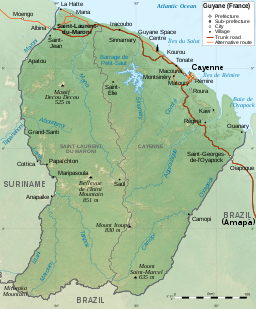
Map of French Guiana
Creative Commons License
Long before Madame Taubira was born, her countryman, Gaston Monnerville was on the path to greatness.

Gaston Monnerville
Deputy of French Guiana - 1932
Monnerville was born in Cayenne in 1897. He studied law at the University of Toulouse. He began his political career by serving as Deputy of Guiana from 1932 – 1946 and as Undersecretary of Colonies in the late 1930s. He served in the Resistance during WWII, followed by a long stretch as President of the Council of the Republic from 1946 – 1958. When the Council of the Republic became the French Sénat (Senate) during the Fifth Republic, he served as president of this legislative body from 1958 – 1968. He went on to serve on the Constitutional Council, the highest constitutional authority in France, from 1977-1983.
Monnerville worked diligently to establish equal rights for the citizens of France’s overseas departments and territories. He was instrumental in having the remains of Victor Schoelcher and Félix Eboué transferred to the Pantheon in 1949.
A commemorative bust was installed in his honor across the street from the Luxembourg Garden on 20 December 2011, in the presence of M. Jean-Pierre Bel, president of the Sénat, and M. Bertrand Delanoë, Mayor of Paris. He died in Paris in 1991.

Bust of Gaston Monnerville
© Discover Paris!
Félix Eboué (1884-1944), was a contemporary of Monnerville.

Félix Eboué and Charles de Gaulle in Chad
Educated in Bordeaux (high school) and at the Ecole Coloniale in Paris, he served in Oubanqui-Chari (Central African Republic) for twenty years and then in Martinique (Secretary General) and French Sudan (Secretary General and Interim Governor of what is now Mali). He married Eugénie Tell in Guiana in 1922 and became a Freemason. In 1936 he was made interim governor of Guadeloupe, the first Black man to be appointed to such a senior post anywhere in the French colonies.
Two years later, with conflict on the horizon, he was transferred to Chad, arriving in Fort Lamy on 4 January 1939. He was instrumental in developing support for the Free French in all of France’s black African colonies in 1940, an action which earned him the position of governor general of French Equatorial Africa and ultimately gave Charles de Gaulle's faction control of the rest of French Equatorial Africa. He died unexpectedly during a visit to Cairo, Egypt.
His wife, Eugénie Eboué-Tell, was a powerhouse in her own right. Born in Cayenne in 1891, she married Félix Eboué in 1922 and went with him to Oubanqui-Chari, Martinique, Sudan, and Guadeloupe before moving with him to Chad on the eve of WWII. During the war, she was part of the Free French Forces and worked as a nurse in a Brazzaville hospital.

Eugénie Eboué-Tell, Sénatrice
© Discover Paris!
After the war, she served as a deputy (representative) for the island of Guadeloupe from 1945-1946 and then Counselor/Senator for the island from 1946-1952. In 1951, she was Vice-President of the Commission for Overseas France, and on July 10, 1952, after leaving the Palais du Luxembourg, she became vice president of the French Union Assembly. She was always a strong advocate for rights in the overseas departments and territories. In 1958, she was elected municipal councilor of Asnieres, a town on the outskirts of Paris.
Eboué-Tell died in the Paris suburb of Pontoise in 1972.
************

If you like this posting, share it with your friends by using one of the social media links below!

© Discover Paris!
Minister Taubira was born in Cayenne in 1952. She is the latest in a string of strongly influential 20th-century politicians from her homeland.
French Guiana is the largest overseas department of France. Located on the north Atlantic coast of South America, it borders Brazil to the east and south, and Suriname to the west. The country is the home to the primary launch site of the European Space Agency.

Creative Commons License
Long before Madame Taubira was born, her countryman, Gaston Monnerville was on the path to greatness.

Deputy of French Guiana - 1932
Monnerville was born in Cayenne in 1897. He studied law at the University of Toulouse. He began his political career by serving as Deputy of Guiana from 1932 – 1946 and as Undersecretary of Colonies in the late 1930s. He served in the Resistance during WWII, followed by a long stretch as President of the Council of the Republic from 1946 – 1958. When the Council of the Republic became the French Sénat (Senate) during the Fifth Republic, he served as president of this legislative body from 1958 – 1968. He went on to serve on the Constitutional Council, the highest constitutional authority in France, from 1977-1983.
Monnerville worked diligently to establish equal rights for the citizens of France’s overseas departments and territories. He was instrumental in having the remains of Victor Schoelcher and Félix Eboué transferred to the Pantheon in 1949.
A commemorative bust was installed in his honor across the street from the Luxembourg Garden on 20 December 2011, in the presence of M. Jean-Pierre Bel, president of the Sénat, and M. Bertrand Delanoë, Mayor of Paris. He died in Paris in 1991.

© Discover Paris!
Félix Eboué (1884-1944), was a contemporary of Monnerville.

Educated in Bordeaux (high school) and at the Ecole Coloniale in Paris, he served in Oubanqui-Chari (Central African Republic) for twenty years and then in Martinique (Secretary General) and French Sudan (Secretary General and Interim Governor of what is now Mali). He married Eugénie Tell in Guiana in 1922 and became a Freemason. In 1936 he was made interim governor of Guadeloupe, the first Black man to be appointed to such a senior post anywhere in the French colonies.
Two years later, with conflict on the horizon, he was transferred to Chad, arriving in Fort Lamy on 4 January 1939. He was instrumental in developing support for the Free French in all of France’s black African colonies in 1940, an action which earned him the position of governor general of French Equatorial Africa and ultimately gave Charles de Gaulle's faction control of the rest of French Equatorial Africa. He died unexpectedly during a visit to Cairo, Egypt.
His wife, Eugénie Eboué-Tell, was a powerhouse in her own right. Born in Cayenne in 1891, she married Félix Eboué in 1922 and went with him to Oubanqui-Chari, Martinique, Sudan, and Guadeloupe before moving with him to Chad on the eve of WWII. During the war, she was part of the Free French Forces and worked as a nurse in a Brazzaville hospital.

© Discover Paris!
After the war, she served as a deputy (representative) for the island of Guadeloupe from 1945-1946 and then Counselor/Senator for the island from 1946-1952. In 1951, she was Vice-President of the Commission for Overseas France, and on July 10, 1952, after leaving the Palais du Luxembourg, she became vice president of the French Union Assembly. She was always a strong advocate for rights in the overseas departments and territories. In 1958, she was elected municipal councilor of Asnieres, a town on the outskirts of Paris.
Eboué-Tell died in the Paris suburb of Pontoise in 1972.
Entrée to Black Paris!™ is a Discover Paris! blog.
If you like this posting, share it with your friends by using one of the social media links below!


