Showing posts with label Ealy Mays. Show all posts

Thursday, April 11, 2013

Black Paris Profiles™ II: Ealy Mays - Part II


Last week I open a new series of Black Paris Profiles with the story of fellow Texan Ealy Mays. This week, Ealy talks about his family and his life in Paris in Part II of this Black Paris Profile.

Ealy Mays
© Discover Paris!


ETBP: When did you move to Paris?

Ealy Mays: I started the process in mid 90s and officially moved in 1997.

ETBP: What brought you here?

Ealy Mays: Paris was another destination in my long expatriate life. After Mexico, my return to the United States re-affirmed my inability to live in America on several counts. I need an intellectual society to think, breathe, and to paint. My type of artwork is expression without borders. A black painter in America is often subjected to too many restrictions and barriers – much of which is imposed upon on us by our own people. In this age of political correctness, it would have been only a matter of time before I would have been sanctioned for some kind of a thought crime through my work, had I stayed in the United States.

ETBP: After all that you’ve experienced during your years of moving and painting around the world, why do you stay here?

Ealy Mays: First and foremost I am a father of a teenage daughter in Paris, and she needs her father. Additionally, I can paint what I want to paint in France. Art is still "art" in this country. Artistic expression is still one of the freest commodities in France, whereas in many countries, including the United States, I would have to conform to the bubble of so-called "black art" or what is "expected" of a black artist. No one is censuring me in France. Here I can paint Paris stories, Russian stories, Mexican stories, anything that I want.

Let me again invoke Richard Wright, who once said "there was more freedom in one block of Paris than in the whole of the United States." That is re-affirmed to me on each visit back home. My mind could never be as free to paint or to compose certain installations in most countries, as it is in France.
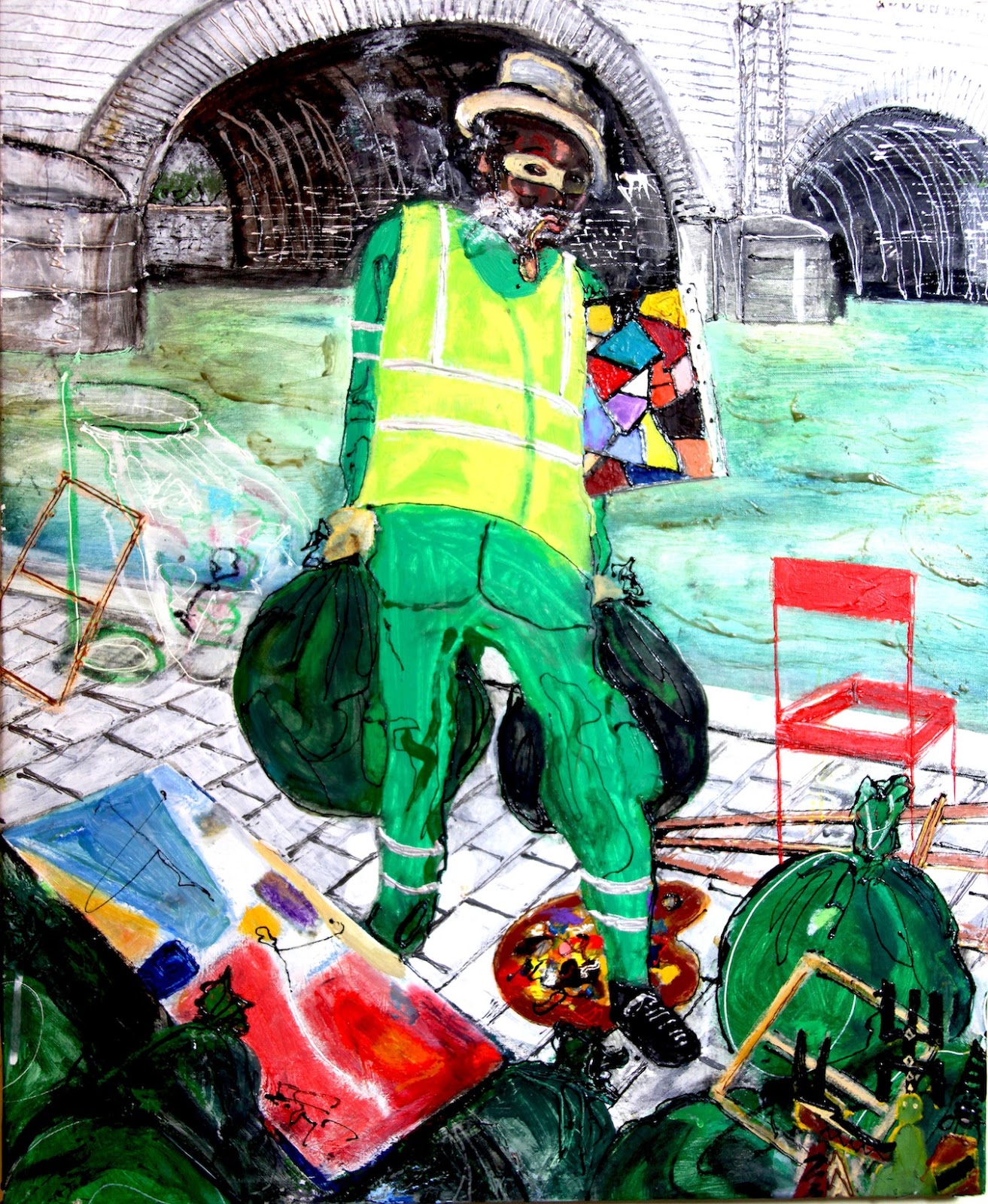
Art Collectors I from the Paris series
2012 Acrylic on canvas
Image courtesy of the artist

I was reminded of this recently in a restaurant in my neighborhood where I was talking to some prospective collectors and showing them some of my work on the wall. An eavesdropping sister overheard our conversation and without even saying hello, she came up to me and asked me "if I ever thought of reflecting my own culture in my work by painting my own people."

Suffice it to say that my almost 40 years of narratives on black history, culture, and legacy, is unparalleled among contemporary artists. This woman knew nothing about my art beyond a few pieces in my friend's restaurant, yet she felt that she was entitled to make such an observation. But she was just being America failing to realize she was outside of America. She was a product of a rude, politically correct, and non-intellectual society that judges before it understands. Can you imagine the forces or censorship and politically correct inhibitors that are born down on many artists in America?

In France, people will start by first asking you about your artwork. In America, they start by visual condemnation, even before understanding the artist’s intent or message. Jacob Lawrence painted Hiroshima, though he was not Japanese. Paris gives me the freedom to mentally roam and create without barriers.

ETBP: A major theme of your Web site is the legacy of black literary and artistic development in Paris. Is a sojourn in Paris a "must" for artists who are developing their skills and their eye today?

Ealy Mays: The art scene for the young artist in Paris is not what it used to be, nor is it what it might be for the young writer. While Paris still holds the key to much intellectual stimulation and development, a young artist without local mentorship or guidance could easily be distracted in Paris, since access and inroads into the art scene are not as readily available now as they were 50, 100, or 150 years ago. The mere survival of an artist is dependent on a few things – selling, exhibiting, and media coverage are among the most important. The French state has certain minimal support for the artist but it has never support the commercial development of the artist.

For the writer it might be easier to come to Paris and thrive because the environment is so conducive to freely writing and to writing freely. For the young painter however, he might be able to paint freely in Paris but he may find that he is not as able to freely paint in Paris if he is not a part of the system of galleries, symposiums, and residencies etc. This is an important distinction.

For young artists, I would recommend a start at the Cité des Arts, much like the one I had. There, they might be afforded the time and ability to somewhat integrate. But again, it should be made clear that the conditions and atmosphere that existed even a generation ago are no longer the same for the foreign artist arriving in France.

Despite what I've just described, I would be disingenuous to discourage any young artist from coming to France. There is something in France that shifts the paradigm of an artist; something that makes an artist thinks differently (you get the feeling Steve Jobs must have lived in France). My only caveat will be for any young artist coming to France to be realistic. Make sure you have the means to eat and pay your rent before you pack up and come. The Seine holds the body of many dead and deranged artists who were very fine painters yet could not feed or house themselves.

ETBP: Tell us about your family (parents, daughter).

Ealy Mays: My father was a doctor. My mother was a schoolteacher. I have one younger sister, two younger brothers, and two elder brothers (who are also doctors).

I am also the proud father of a 14-year-old daughter who is half French and being educated within the French system. I homeschool her on American culture and ensure that she spends vacations in the US with her grandmother, her aunt and uncles, and her extended cousins.

I come from a long family of intellectuals and independent-minded Texans. Famed educator Benjamin Mays is a distant relative. My grandmother, a violinist, housed the great diva Marian Anderson when Anderson performed in Texas and could not find a room in the whites-only hotels.

Ealy and The Texas Last Supper
© Discover Paris!

My family has been in Texas for some 200 years, way before Texas became a state in the Union. We are proud Texans, albeit with strong and deep roots and connections to my hometown (and that of Paul Laurence Dunbar) of Dayton, Ohio, where my father chose to settle his family after medical school due to Ohio’s then strong industrial base and high quality of life for African Americans.

ETBP: You earned art certificates during your years in Dayton and yet you pursued a Batchelor’s degree in chemistry and biology at Wiley College and a medical degree at the University of Autónoma. Tell us how / why you abandoned your medical career to become an artist.

Ealy Mays: I was always an artist. My father was a doctor. My two older brothers became doctors. It seemed the logical thing to do to follow in my father’s footsteps. A son with high regards for his father will always feel a need to obtain his father’s ultimate approval by following in his footsteps. But the more I progressed in my medical studies, the more I wanted to paint, the more I realized that I painting was all I could do. I was and would always be an artist.

ETBP: Did your pursuit of the science and medical degrees represent a switch, or did you continue to pursue art while you were in college and med school?

Ealy Mays: No, it did not represent a switch at all. In fact while in Mexico, I continued to paint and to exhibit, such as annual exhibitions in the Fiestas de Octubre. I became the artist to many in the Mexican "moneyed" strata, who regularly commissioned me to paint portraits and masterpieces of Mexican scenery for their families. So established did I become as a local artist that I even assumed the name "Ealy Mayo" as a nod to legitimize myself as a local painter.

In 1989, my work Last Train to Chihuahua took runner-up to first prize in the José Clemente Orozco annual art competition, which was one of the most famous art competitions in Mexico. It was speculated then that I lost out to the first prize due mainly to being a non-Mexican painter.
Last Train to Chihuahua
1989 Oil on canvas
Image courtesy of the artist


Later on, meeting legendary and then aging Mexican painter Rufino Tamayo, who painted the red watermelon, influenced my decision to paint the blue watermelon, which I felt had more resonance and cultural implications for me. I saw the satirical value in that here was a Mexican giant who was painting watermelons where there were so many culturally stereotypical implications with the watermelon for me as an African American.

It was the same thought process for me with my Mammy series. Why should Andy Warhol make millions with his "Diamond Dust Mammies" from the objectified portrayal of the black maid? So I started to paint Mammy with a meaning – by highlighting her contributions to the evolution of the American society, being that she was the one who took care of us all, black and whites, and would sacrifice to see her offspring become mainstream in every echelon of American society – politics, law, sports, entertainment, education, literature, medicine, and science.

ETBP: Is your daughter a source of inspiration for your painting?

Ealy Mays: Yes of course. My daughter is my inspiration for living, and I am the only thing between her and a French identity of being a "brown French woman." From her father, she learns her identity as an African American and as a black woman in France and among the global diaspora.

ETBP: Do you have any final thoughts that you wish to share with those aspiring to become a professional artist?

The words of my father: Imitate, Initiate, and Create. I would add, be original in thoughts, forms, and compositions. Try to create original forms. Create artwork from the social critic within, as opposed to work based on the needs and likes of the art critic in newspapers. Resist the urge to conform. Originality is essential to being an artist.

ETBP: You say that your father told him to imitate, initiate, and create. But you go on to talk about how important originality is, which would seem to contradict your father’s advice. Please elaborate on this.

Ealy Mays: Even in imitation, there is originality. Original forms may be created, renewed or evolved from old sources, or might emerge from the destruction of other forces. The dinosaurs gave way to us...yet one could argue that humanity is an original form. African art gave way to Picasso...yet he created original forms belied by imitations.

************


Entrée to Black Paris!™ is a Discover Paris! blog.

If you like this posting, share it with your friends by using one of the social media links below!

Thursday, April 4, 2013

Black Paris Profiles™ II: Ealy Mays - Part I


I am pleased to open a new series of Black Paris Profiles with the story of fellow Texan Ealy Mays, a brilliant, prolific artist and a long-time member of Paris’ African-American expatriate community. I have been intrigued by his work for years and am particularly enamored of his “Mama” series, inspired by Leonardo’s Mona Lisa.

Ealy Mays
© Discover Paris!


Purple Mona Lisa from the "Mama" series
© Discover Paris!

Part I of my interview with Ealy delves into what drives him as an artist.

ETBP: What is / are your goal(s) in painting?

Ealy Mays: Like Balzac, I would a liar if I said that I did not paint for the money. But the realities of the contemporary art world are such that when I left the US over three decades ago, I probably left the chance to realize real money from my art anyway. The truth is that I paint out of the pure passion for painting. It is pretty much all I know how to do, and all that I have ever done. The goal of a true painter will always be the creation of work with which she/he is satisfied and not at all the pursuit of money. True artists pursue compositions and creation of original forms. The art market pursues money.

ETBP: What or who inspires you to paint?

Ealy Mays: Richard Wright once expressed that writing enabled to him to live and to breathe. Painting for me is much the same way. It is my oxygen. I breathe through painting and expressing the world I see around me, albeit with a paintbrush or through mixed media composition.

As for those who inspire me, the list includes Mexican muralists Diego Riviera and José Clemente Orozco; Franz Kline, Rufino Tamayo, Max Parrish, Jackson Pollack, Herbert Gentry, and Ed Clark, among others.

ETBP: Which media do you prefer to use when you paint and why?

Ealy Mays: No preference. I started off as a child with acrylic and did my first oil painting at about age 10. Many other forms of expression are sometimes more appropriately conveyed in varying mixed media, so for me, the artistic medium varies with the images and messages.

The Radical Submarine
2005 Mixed Media: Acrylic on Wood Panel
Image courtesy of the artist

ETBP: Of all the series that you have created, which is your favorite?

Ealy Mays: One was "Search for Spartacus," which was a series examining the search for the leader of one of the most notorious slave revolts in the history of mankind. Unfortunately, this series of over 16 paintings was stolen by a man who was presented to me as an art agent in the late 90s.  He ended up taking my paintings to Germany, never to return them. I successfully had him arrested by Interpol in Paris, and he was jailed for some time and forced to make restitution, but he never really paid up fully for the paintings and I never retrieved my paintings.

Another of my favorite series was the "Crucifixion of Nzinga," painted when I lived in Mexico. Nzinga was the queen of an African kingdom who tried to keep Christianity out of her land. Hers was a free kingdom where slavery was not practiced. By the time of her death, she had been given a new Portuguese name, "Anna," and it was then falsely claimed that she had "willingly" converted to Christianity. This is highly doubtful, but it just goes to show that making history is not good enough. We have to write, paint, and otherwise document our own history.

Most of the paintings in this series were of black women on white crucifixes. This was too much for the sensitivities of a Catholic Mexican society, and one day, the Mexican army arrived, branded the artworks "decadent" (much like the Nazis did in WWII for the works of artists such as Max Ernst).  They seized all of the pieces. I was later told that many of them hung proudly in the home and office of a Mexican general involved in the seizure.

ETBP: Your Web site bio indicates that Jacob Lawrence described you as the best narrative painter he ever met. Tell us what a narrative painter is.

Ealy Mays: Much like a writer who writes short stories or a documentarian who captures and presents historical events, a narrative painter is an artist who tells a story. An example of this is An American in Paris II: Island of Hallucination, which was recently auctioned for $7500 at a charity event for Evidence, A Dance Company in NYC. The event was chaired by Spike and Tonya Lewis Lee and Reginald Van Lee (no relation), and hosted by actress Lynn Whitfield.

This painting tells the story of the treachery that engulfed the African-American expat community in the 50s, culminating with the Gibson Affair. Its title is borrowed from the title of Richard Wright's last (unpublished) novel, Island of Hallucination, and it features some of the principal characters of l'affaire Gibson. But it also fuses subtexts of race and gender interplays within the larger American community in Paris.  On March 25, 2013, not only was a piece of artwork auctioned for a good cause, but a piece of African-American history in Paris was also disseminated to an entire ballroom of dignitaries and celebrities at the Plaza Hotel in NYC.

An American in Paris II: Island of Hallucination
2009 Oil on canvas, Mixed Media
Image courtesy of the artist

ETBP: What does Lawrence’s description mean to you?

Ealy Mays: To be recognized by a black artist of such a stature was an affirmation then of what was my lifetime as a painter. I did Skowhegan with Jacob Lawrence on my return from Mexico. This was after my graduation from UAG (Universidad Autónoma de Guadalajara) and after a decision against a medical internship. It was a definitive march forward ahead as an artist and not as a doctor. Receiving such an affirmation from the man who had done the "Migration" series - on African Americans moving from south to north, as well as the "Hiroshima" series, capturing a cultural experience (Japanese) that was not his - was quite a moral boost for me. Lawrence’s affirmation told me that it was OK to be an African-American painter whose work reflects his own community as well as captured experiences of other cultural backgrounds.

ETBP: You have no formal degree or training in art, yet you have been painting for over 30 years. What do you advise youngsters who want to become artists regarding the pursuit of formal training?

Ealy Mays: I have actually been painting for over 40 years. In fact, my first art show was at the White House in a show called Art for Kids with President Lyndon Johnson in 1967.

I would advise young artists to follow their passion, knowing well that their destinies will be affected by others in the form of critics, galleries, museums, the art market, etc. But they should not ever be deterred by any of the aforementioned. Critics do not hold the key to the soul, nor to an artist’s ability to express. The art market might deny you money in terms of the true worth of your talent but it will never deny you your talent.

ETBP: Tell us about the business of being an artist. How much time to you spend on the business aspects of your career?

Ealy Mays: Almost none. I focus on painting. I do engage to sell my work locally and internationally but in doing so, I could never really realize the real value of my work in monetary terms. Selling ones work is not really "dealing with the business of being an artist," since that business is done through galleries, agents, art advisers, art brokers, auction houses, etc. I have a painting entitled The Writer, Actor, Producer, and Director, which speaks alternately to needing the middleman as well as to cutting out the middleman.

The reality is that most artists are not equipped to do both art and the business of art as well. If we were good at business, we would have gotten MBAs. Paul Sinclair (my agent) deals with the business of art. Ealy Mays deals with being an artist.

Visit the blog next week for Part II of this interview, which explores the personal side of Ealy Mays.

************


Entrée to Black Paris!™ is a Discover Paris! blog.

If you like this posting, share it with your friends by using one of the social media links below!

Wednesday, July 21, 2010

Mona Lisa in Black

Leonardo's Mona Lisa is probably the world's most famous painting. It hangs in the Louvre, and draws countless thousands of visitors to the museum every day.  Numerous artists have been inspired by this work, and have created their own art using Mona Lisa's image.

Ealy Mays is one of these artists.  He has teamed up with the Paris bookstore Mona Lisait (which means "Mona read " [past tense]) for an exposition of several of his Mona Lisa-inspired works.  These works are part of a series of paintings that he has christened "Mama."

Caribbean Mama (Is There Life on Mars?)
2010, Oil on canvas
© Discover Paris!

Mona Lisa Likes Pancakes
2010, Oil on canvas
© Discover Paris!

Yellow Mama Lisa
2010, Oil on canvas
© Discover Paris!

Mays is a Texas native and long-time Paris resident. He is a prolific painter, and has produced at least ten works that in some way make reference to Mona Lisa.  Many works from his "Mama" series also feature Aunt Jemima, either alongside Mona Lisa or alone.  Mays does not hesitate to include elements from previous series of his in current paintings - an example is the blue watermelon from his "Blue Watermelon" series in Yellow Mama Lisa.

Social commentary through art is a prominent feature of Mays' oeuvre.  His painting Obama in Paris is a prime example of this:

 Obama in Paris
2008, Oil on canvas
Image courtesy of Ealy Mays

Obama is seen in the lower register of the painting, looking upward.  The kiosk bears colorful images of Paul Colin's famous portrayal of Josephine Baker in her banana skirt, the Banania man, Aunt Jemima, a self-portrait of Beauford Delaney, a photograph of Alexandre Dumas, père, and other persons or objects relevant to black history and culture.

For a close-up view of this painting, click here. (Prints are available from Dorothy's Gallery.)

Mays has a studio on rue Christine in the 6th arrondissement, and paints at the Cité International des Arts on rue de l'Hôtel de Ville in the 4th arrondissement every summer. The Metropolitan Museum of Art and the New York Guggenheim are among the world-renowned museums that have displayed his works.

 Ealy Mays
© Discover Paris!

Joe Langley filmed the vernissage (the opening of the exposition) on June 15, 2010.   Click here to see the video.

To see the current exposition at Mona Lisait, visit the store at:
6, rue Danton
75005 Paris
Tel: 01 43 29 57 72 
Metro: Odéon - Saint Michel

The expo will hang until August 31, 2010.

To see an online gallery of Mays' work, visit his blog at http://ealymays.blogspot.com/ or his MySpace page at http://www.myspace.com/ealymays. 

************

Want to read more about the hidden jewels that comprise the "real" Paris – the people and places that are the true heart and soul of the city – and receive our free guide called "Practical Paris"?  Click here to sign up for our newsletter announcements today!


  Entrée to Black Paris™ is a Discover Paris! blog.