Showing posts with label Chester Himes. Show all posts

Thursday, May 30, 2013

A Paris Vacation

I received this testimonial from Cheryl Adams, a client who came to Paris earlier this month with her sister, Delores. It expresses perfectly what I hope to have you experience by taking an Entrée to Black Paris tour!

************

Cheryl Adams, Monique Y. Wells, and Delores Jones
on the "Black Paris after World War II" tour
© Discover Paris!

Just last week I took my life-long dream vacation to Paris, France. To say I had a wonderful time does not do my experience justice!

I, along with my sister Delores, took in all the noted tourist attractions: the Louvre museum, the Eiffel Tower, Notre Dame Cathedral, the Arc de Triomphe, the home of Monet, and Palace Versailles, just to name a few.

My week of excitement culminated with a tour given by Ms. Monique Wells of Entrée to Black Paris. When I learned of my trip, which was a gift from my daughter, also included was information on Entrée to Black Paris. I signed up to receive information Ms. Wells posted on her blog, and for nine months I followed her informative posts. I also read her books – Black Paris Profiles and Paris Reflections: Walks through African-American Paris. I had read and heard stories of black Americans living in Paris and wanted to learn more.

This was not the usual run-of-the-mill tour! This walking tour focused on the lives and accomplishments of Black Americans along with other black expats. Monique’s casual style made for a wonderful stroll through the streets of Paris that other tours did not offer. She was a wealth of knowledge about noted persons such as James Baldwin, Richard Wright, Chester Himes, and Alexandre Dumas. Her stories made for a visual of how black people lived their lives in Paris after WWII. She peppered facts with tidbits of little known information, most quite humorous. If you know anything about the great black writers, poets, artists, performers, and political activist of post WWII, this tour will enhanced your understanding of their lives.

I wish that I had scheduled a longer time for the tour, because I felt that Monique was just getting started. The walk was so intriguing that I had a renewed interest in many of the persons mentioned.

The Entrée to Black Paris tour was the highlight of my dream vacation, so if ever you plan a visit, be sure to include it in your itinerary. On my next trip, I definitely will!

************


Entrée to Black Paris!™ is a Discover Paris! blog.


If you like this posting, share it with your friends by using one of the social media links below!

Thursday, May 2, 2013

An Evening of Readings Inspired by Tannie Stovall's Book Collection


On the evening of Saturday, April 20th, a lively group assembled at the home of Kathleen Dameron to listen to a series of short readings inspired by the book collection of Tannie Stovall. Kathleen is the guardian of what is now the Tannie Stovall Memorial Library, a collection of ~170 books that Tannie entrusted to Kathleen for safekeeping. His desire was that his books, including those that he authored, be the source of stimulating conversation and the instigators of lively debates on sociopolitical and cultural issues.

Kathleen and Cheryl Pegues co-organized the event and five people read that evening. Each explained why he or she thought the passage selected was appropriate for the event and then proceeded to recite it for the group.

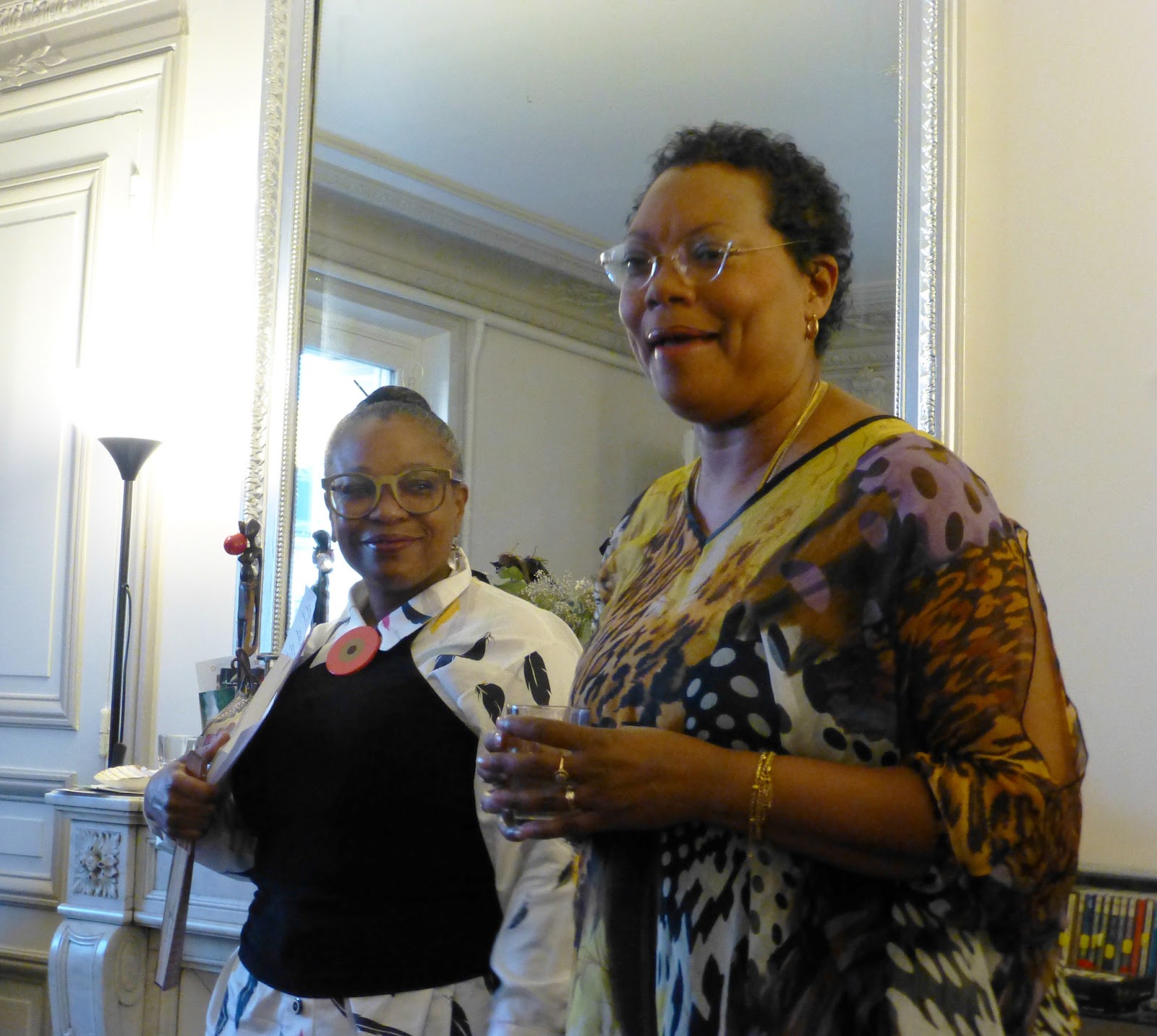
Cheryl Pegues and Kathleen Dameron
© Discover Paris!

Ellen Kountz read from an essay called "Blacks Don't Read: They Are Still Our Slaves." It has become somewhat of an urban legend. Though its source is unknown, it is powerful food for thought.

Ellen showing a photo of Tannie and friends
© Discover Paris!

Curtis Robert Young reminisced about his hometown of Chicago and talked about his son, who worked for the Obama administration, before reading a passage about a community meeting at a church in Chicago from Obama's Dreams from My Father.

Curtis Robert Young
© Discover Paris!

Cheryl selected a passage from the first chapter of The Spook Who Sat by the Door, a novel by Sam Greenlee. The book is a favorite of her current beau and coincidentally is one that Tannie read and loaned to someone. Cheryl donated her copy to the library.

Cheryl standing before the audience
© Discover Paris!

Randy Garrett read from Tannie's last novel, Two Centuries in Two Weeks. He selected a passage that explains why Ralph, the African-American protagonist of the book, has decided to take his own life.

Randy Garrett
© Discover Paris!

Finally, Jake Lamar read from Chester Himes' The Quality of Hurt, fondly remembering how Tannie expressed disdain and disbelief when Jake admitted that he had not read any of Himes' work prior to coming to Paris.

Jake Lamar
© Discover Paris!

After the readings, a scrumptious Indian-Mauritanian buffet was served and the group danced and chatted for the duration of the evening.

Dancing
© Discover Paris!

The Tannie Stovall Memorial Library will eventually become a lending library.

The Library
© Discover Paris!

To learn more, contact Kathleen Dameron at .


************

Tannie Stovall, Cheryl Pegues, Ellen Kountz, and Jake Lamar are all featured in the Discover Paris! publication Black Paris Profiles. Click here to learn more about the book.

************


Entrée to Black Paris!™ is a Discover Paris! blog.

If you like this posting, share it with your friends by using one of the social media links below!

Thursday, February 28, 2013

Brothers in Exile – A Play by Jake Lamar


When I published the Black Paris Profile on Jake Lamar in November 2011, he had already begun work on a play about the friendship/rivalry between Richard Wright, James Baldwin, and Chester Himes in Paris in the 1950s. He was writing it in both English and French and planned to begin “workshopping” it (having actors and a director playing out scenes before a play goes into formal rehearsals) within a year.

Fast forward to 2013…

On February 25th, Jake’s dream was realized when Beaumarchais-SACD – a French association that supports writers and producers of the performing arts – sponsored a reading of Brothers in Exile. Because I love the theater and because it is rare to be able to associate French theater with the African-American presence in Paris, I was determined to attend. I was proud to be present at this historic event!

The evening unfolded in the Salle Jean Tardieu at the Théâtre du Rond Point, near the roundabout where avenue Franklin D. Roosevelt meets the Champs Elysées. The salle (room), which holds 176 persons, was filled to capacity.

Théâtre du Rond Point
© Discover Paris!


A screening of an outstanding French short film (Avant que de Tout Perdre – 30 minutes) was followed by the main attraction, where a cast of three principle actors, a reader, and five additional characters breathed life into Brothers in Exile on stage for the first time.

The Cast
© Discover Paris!


The fictional story revolves around Wright’s death and an official inquiry by the French authorities into Himes’ and Baldwin’s potential involvement. It moves back and forth in time. For this one-time staging, William Nadylam played Richard Wright, Cyrl Guei portrayed James Baldwin, and Alex Descas represented Chester Himes.

William Nadylam as Richard Wright
© Discover Paris!

Cyril Guei as James Baldwin
© Discover Paris!

Alex Descas as Chester Himes
© Discover Paris!

The reading was performed in French. To see French actors interpreting these quintessentially American personas was fascinating! One of my favorite moments during the reading occurred during an exchange between Wright and Himes. Nadylam (Wright) emphasized the syllable “po” in the French word “policier,” which means “crime story.” He was evoking the way in which many African Americans emphasize the syllable “po” when they talk about the police. It was comical cultural reference that was lost on most of the French audience.

Jake had wanted to write a novel about the relationship between Wright and Baldwin since his days in New York. He learned of the confrontation that occurred between the two authors at the Deux Magots café on boulevard Saint Germain des Prés when he was a student at Harvard during the early 80s. In researching his 2001 Washington Post review of the Hazel Rowley biography of Wright, he learned that Chester Himes had been present during this altercation. Later, upon reading the first volume of Chester Himes’ autobiography – The Quality of Hurt – he read Himes’ version of what had transpired. Now Himes would play a role in the novel that he had been envisioning.

Then, on April 30, 2011, it suddenly occurred to him that the novel he wanted to write should be a play. Through his work at the community theater in Bobigny (MC 93), he had learned that the stage provides much more creative freedom than he realized and saw the potential in having the voices of his three protagonists be heard as opposed to simply being read. He created a one-page sketch as the outline for the play and remained faithful to it throughout most of the writing process.

Jake began researching the play in earnest in early summer 2011 and also began the search for financial backing, writing proposals in English and French. This is when he learned of the grants that Beaumarchais-SACD offers to support creators of theater, dance, film, and other performing arts. He submitted his proposal in October 2011 and in February 2012 he learned that his was one of three out of 250 submissions to be accepted for funding!

Having written numerous articles and books, Jake was surprised to find that he never enjoyed writing anything as much as he enjoyed writing Brothers in Exile. He loved writing for Wright, Himes, and Baldwin, inventing circumstances for them but building those circumstances around the information that he learned from reading books by and about these authors. He finished the English version in August 2012 and then began work on the French translation with his wife Dorli. One full year after submitting his proposal to Beaumarchais, he finished the play.

Jake was responsible for finding the director and the actors for the reading. Through personal and professional connections, he engaged the three principal actors and director Pierre Laville. Laville was responsible for casting the remaining actors.

What lies ahead for Brothers in Exile? Jake’s agent has submitted the play to numerous theaters in London, New York, and a couple of additional theaters on the East Coast in the U.S. Jake has personally submitted proposals to theaters in France.

A suivre… To be continued…

************


Entrée to Black Paris!™ is a Discover Paris! blog.
We are proud to have been selected as one of 10 BEST Paris blogs!

If you liked this article, share it with your friends and colleagues by clicking on one or more of the social media buttons below!

Thursday, November 3, 2011

Black Paris Profiles™: Jake Lamar

I have had the pleasure of interviewing writer Jake Lamar on more than one occasion, including an exchange that led to a feature article on Africana.com in 2004, shortly after the publication of his fourth novel, Rendezvous Eighteenth. A lot has happened since then, so I contacted Jake for an update. Read on to find out what twists and turns his career has taken in the last seven years.


***********


Jake Lamar
© Mimi Haddon

Jake Lamar is a novelist and a journalist. On the journalist side, he contributes to the The Root, “the leading online source of news and commentary from an African-American perspective.” At the time of this writing, his latest article for the publication addressed the domestic terrorist attack in Norway. On the novelist side, he is working on a book that is a big departure from his “normal” genre – he says that “it’s not a thriller, it’s not set in Paris, and it does not deal with racial questions.”

************

Black Paris Profiles™ is now available on Kindle.  Only excerpts are available on this blog.
To get your copy of Black Paris Profiles™, click HERE.

************


Entrée to Black Paris!™ is a Discover Paris! blog.

If you like this posting, share it with your friends by using one of the social media links below!


Thursday, October 21, 2010

Montparnasse Unveiled

Each month, our Paris Insights newsletter presents the hidden jewels that comprise the "real" Paris – the people and places that are the true heart and soul of the city. Click here to sign up for our newsletter announcements and to receive our free guide called "Practical Paris”!

************

Several weeks ago, I had the pleasure of conducting a private, guided walking tour with Dr. Celeste Hart. She engaged Discover Paris! for several activities and products (as you will read in her testimonial below), one of which was a walk through Montparnasse. We spent two hours wending our way through the streets, conjuring up the spirits of the African-American and Bohemian past that made the district unique and famous.


Monique and Dr. Celeste Hart catching a glimpse of the courtyard
of an old artists’ studio complex from the early 20th century.
© Discover Paris!

*********************
Dr. Hart’s testimonial:

I recently engaged Discover Paris! to provide private, guided Afrocentric tours of the Louvre Museum and the Montparnasse district of Paris. I also purchased two of their downloadable walks – one on Richard Wright’s Paris and one on Josephine Baker’s Paris (The Black Pearl Walk).

I enjoyed both private tours immensely. They were filled with information and perspective that I couldn’t have gotten elsewhere, and I was able to engage the guides with questions and discussion that would not have been possible in a group tour. The guide for the Louvre tour provided a lively commentary which drew on her broad understanding of art history to provide fascinating insights into the significance of the inclusion of blacks in works of art spanning 3 centuries.

A special highlight of the Montparnasse tour was a dossier of rare photographs that the guide used to illustrate her discussion. Being able to see photos of the artists and their works as we passed their studios and favorite haunts added greatly to this experience. It was surprising to see how little some of their studios have changed over the years.

The downloadable walks contained remarkable detail about the places that Richard Wright and Josephine Baker frequented during their time in Paris.

Celeste B. Hart, M.D.
Tallahassee, FL
***********************

The beauty of Montparnasse does not lie in its architecture – the city razed the vast majority of the district during an urban renewal project in the 60s and 70s to construct mostly character-less buildings. The beauty of Montparnasse lies in its history, much of which is unknown to the average traveler. It teems with stories of artists and writers who came to Paris for a better life, beginning at the turn of the 20th century. African-American artists such as Henry Ossawa Tanner, Hale Woodruff, and Loïs Mailou Jones contribute as much to this history as do European artists such as Picasso, Pascin, and Modigliani.

Beauford Delaney, whose memory we recently honored by inaugurating his new tombstone, called Montparnasse home for the majority of the roughly twenty-six years that he lived in Paris. African-American writers James Baldwin and Chester Himes spent time there as did white American writers Ernest Hemingway and F. Scott Fitzgerald. Herb Gentry and his wife Honey Johnson operated a business near the Carrefour Vavin that was an art gallery by day and a jazz club by night. And we can’t forget that Josephine Baker performed for the final time of her life in Montparnasse…


Funeral procession for Josephine Baker
in front of the Bobino Theater, Montparnasse

Take Discover Paris!’ Entrée to Black Paris™ tour of Montparnasse and feel the artistic and literary pulse of this quartier beat again! For more information, contact us at info(at)discoverparis(dot)net.

************


Entrée to Black Paris!™ is a Discover Paris! blog.


Wednesday, August 11, 2010

Café Tournon

Ayanna and Char across the street from the Café Tournon
© Discover Paris!

A few weeks ago, I had the pleasure of providing the two lovely ladies pictured above with a private walking tour of the 5th and 6th arrondissements.  Our topic was Black Paris after World War II, and the final point of interest was the Café Tournon (visible in the background).  I talked at some length about the African-American expats who hung out at the Tournon during the walk, so by the time we arrived, Ayanna and Char were ready for a couple of stories that unfolded at the café.  These epitomize the humor and drama that characterized the relationships of the men who comprised the group.

I read a passage from William Gardner Smith's essay "Black Man in Europe" from Return to Black America, which describes the camaraderie of the group.  It included Richard Wright, Ollie Harrington, Chester Himes, and many others.  Smith described Harrington's keen storytelling ability, and spoke of the "raucous laughter that reverberated from the room" when Harrington told a joke.  He indicated that conversation often drifted toward the race problem in the U.S., and whether or not France was any better in this regard.

I then relayed the story of the "Gibson Affair," a tale of conflict, deceit, and accusations of espionage that proves the old adage that "truth is stranger than fiction."  Richard Gibson, a journalist at Agence France Presse (where Smith also worked), and Ollie Harrington had an altercation about Gibson's sublet of Harrington's apartment.  The two argued, and even fought publicly, over this issue.  But the underlying story of a plan to support the Algerian effort in the Franco-Algerian war that went awry, involving Gibson, Harrington, Smith, and others, marked a turning point in the relations among the African American expats of the era.

Café Tournon is well aware of its connection with African-American history in Paris.  Once, a waiter brought over a photo of Duke Ellington and Beauford Delaney seated in the café to a group that I led on a Black Paris walk.

Duke Ellington and Beauford Delaney at the Café Tournon
Photo from Paris Noir by Tyler Stovall

The Tournon's Web site acknowledges this history on a page entitled "Historique," which is complete with photos.  It also mentions the literary group Paris Review, founded by George Plimpton, Peter Matthiessen, Howard L. Humes, and others in 1953, that met regularly at the café.  William Gardner Smith (top row, second from right) and Wilma Howard (bottom row, first left) were members.

1954 Paris Review
Photo from the Wall Street Journal (obtained from the Morgan Library)

The façade of the café has changed a few times over the past ten years, and the interior has been refurbished.  But the "hideous paintings of the Luxembourg Gardens on the walls," described by William Gardner Smith in "Black Man in Europe," are still there!

Café Tournon
© 2001 Discover Paris!

Café Tournon
© 2005 Discover Paris!

Café Tournon
© 2009 Discover Paris!

Café Tournon interior
© 2009 Discover Paris!

Cafe Tournon
18, rue Tournon
75006 Paris
Tel: 01.43.26.16.16
Metro: Odéon (Line 10)
************

Want to read more about the hidden jewels that comprise the "real" Paris – the people and places that are the true heart and soul of the city – and receive our free guide called "Practical Paris"?  Click here to sign up for our newsletter announcements today!


Entrée to Black Paris!™ is a Discover Paris! blog.


Thursday, July 29, 2010

Remembering Chester Himes

Chester Himes was born on this day 101 years ago.

Himes was one of a number of African-American expats who settled in Paris after WWII. He later wrote a fascinating account about his life there in his autobiographies The Quality of Hurt and My Life of Absurdity.

Himes had already established himself as a writer in the United States with critically acclaimed novels such as If He Hollers Let Him Go and Cast the First Stone before he moved to Paris. Though he continued to write "serious" novels in Paris, he eventually turned his creativity toward a series of detective novels commissioned by the French publishing house Gallimard. These works, which featured detective characters “Coffin” Ed Johnson and Grave Digger Jones, propelled him to success in the French literary market. All were translated into French, and were more successful in France than in the U.S. They would become Himes’ literary legacy.

Himes finished the first novel for Gallimard’s La Série Noire in 1957. He called it The Five-Cornered Square in English, and Gallimard christened the French version La Reine des Pommes. Himes wrote it while living at the Hôtel Rachou at 9, rue Git-le-Coeur in the 6th arrondissement. He was the first celebrity writer to inhabit the hotel, which would become renowned as the beatnik hotel, or Beat Hotel.

Hôtel Rachou
Photo by Harold Chapman


Hôtel Vieux Paris (formerly the Beat Hotel)
© Discover Paris!

In the same year, Himes would write A Jealous Man Can’t Win (renamed The Crazy Kill) at the Café Select. He claimed not to like the waiters or the clientele there, but he used the café as his workplace nonetheless.

 Café Le Select
© Discover Paris!


La Reine des Pommes won the Grand Prix du Roman Policier (Grand Prize for the Detective Novel) in 1958, and catapulted Himes to celebrity status in France. The Five-Cornered Square was renamed For Love of Imabelle, and later, A Rage in Harlem.


Already celebrated for his detective series, Himes’ popularity was considerably boosted as a result of two major press events organized in Paris. The first, in 1964, culminated in a feature article about him in Condé Nast’s Adam Magazine. The second, in 1970, was a five-day publicity event arranged by Gallimard to promote Himes’ novel Cotton Comes to Harlem, which had been released as a movie in that year by Samuel Goldwyn, Jr.  Gallimard summoned Himes from his home in the Alicante province of Spain for the second event, booking him and his wife Lesley into the Hôtel Pont-Royal on rue Montalembert. Le Monde ran a two-page spread on him, and Life Magazine ran a two-page spread on the movie, as well as a feature article on Himes.

Editions Gallimard
5, rue Sébastian Bottin, Paris 7e
© Discover Paris!


 Hôtel Pont-Royal (Hôtel Littéraire)
7, rue Montalembert, Paris 7e
© Discover Paris!

Himes lived in Paris off and on during the years that he resided in Europe, spending time in the south of France, Germany, Denmark, England, and Spain. He died in Moraira, Spain (near the city of Alicante) in 1984, and is buried nearby at a cemetery in Benissa.

************

Want to read more about the hidden jewels that comprise the "real" Paris – the people and places that are the true heart and soul of the city – and receive our free guide called "Practical Paris"?  Click here to sign up for our newsletter announcements today!


 Entrée to Black Paris!™ is a Discover Paris! blog.