Showing posts with label Sidney Bechet. Show all posts

Thursday, September 3, 2015

Black Paris Documentary Wins Big at Film Festival in Berlin


A few days ago, a big envelope showed up in the mail box of long-time film directors Joanne and David Burke. When Joanne opened it, she found that she has won a Best Film/Video award from the 30th annual Black International Cinema festival in Berlin as director of her documentary series When African Americans Came to Paris, Part I & II (The Stars). The award category for which she won is "Video on Matters Relating to the Black Experience/Marginalized People."

Joanne Burke
Image courtesy of Joanne and David Burke


Award certificate - Black International Cinema Film Awards
Image courtesy of Joanne and David Burke

Joanne is a film and video director-producer-editor with several years of high-level experience. From the late 1960s to 1986, she was one of the top documentary film editor​s in New York, editing more than twenty long-form documentaries for CBS, NBC, PBS, and HBO on social, political, and cultural themes.

Since she moved to Paris in 1986, Joanne has produced, directed, and edited a number of additional documentaries. Her award-winning film on jazz great Mary Lou Williams - Mary Lou Williams: Music on My Mind (1990) - has been broadcast on PBS, CBC in Canada, Arte, and a number of other channels in France. All these films have been independently produced in partnership with her documentary filmmaker and former 60 MINUTES writer/producer husband, David Burke.

David Burke at American Library of Paris presentation of
When African Americans Came to Paris - Part I
© Discover Paris!

When African Americans Came to Paris focuses primarily on the period between 1900 and the 1930s, a segment in the history of African Americans in Paris that is much less well known compared to that of the post-World War II era.

Part I is comprised of six videos:
  • W. E. B. DuBois and the 1900 Paris Exposition
  • Henry Ossawa Tanner: An Artist in Exile
  • The Harlem Hellfighters
  • James Reese Europe: Warrior and Musician
  • Jazz Comes to Paris
  • Three Women Artists in Paris

When African Americans Came to Paris - Part I
Image courtesy of Joanne and David Burke

Part II consists of three videos:
  • Josephine Baker: A Most Extraordinary Life
  • Sidney Bechet: The Wizard of Jazz
  • Black Writers across the Atlantic

When African Americans Came to Paris - Part II
Image courtesy of Joanne and David Burke

I have had the pleasure of viewing both parts of When African Americans Came to Paris. The commentary by pre-eminent scholars combined with the (often rare) video clips and photos bring historical African-American Paris alive like no other film or video that I've seen to date!

Each video can stand alone. My favorite is "Three Women Artists in Paris," found in Part I, which provides excellent and well-needed exposure for the African-American women whose stories are so often overlooked in conversations about "black Paris."

When African Americans Came to Paris has been released by Blue Lion Films in partnership with Julia Browne of Walking the Spirit Tours. To view the trailers and to purchase, click HERE.

************


Entrée to Black Paris!™ is a Discover Paris! blog.

If you like this posting, share it with your friends by using one of the social media links below!

Thursday, July 26, 2012

Josephine Baker at Paris en Chansons Exhibition


The city of Paris has mounted a phenomenal, one-of-a-kind exposition called Paris en Chansons that features the celebration of the City of Light in song. The exhibition traces the history of songs about Paris since the Middle Ages. More recently, artists from Aristide Briand to Vanessa Paradis have crooned about Paris' monuments, social life, metro, and everything in between!

Among this group, black artists are few. But one of them remains larger than life: Josephine Baker.

Josephine's face graces the flier that publicizes the event. Inside the exhibit, an illustration of her by Jean Dunand and the program for her performance run in the show Paris qui Remue at the Folies Bergère are the first documents shown in the display table on the ground floor. On the lower level, where the majority of the exposition is mounted, you find numerous items that highlight Josephine's immortalization of Paris in song. Among them are the cover of the sheet music for her recording "Paris Paris Paris," the cover for her album entitled Joséphine Chante Paris, and a video of her singing "J'ai Deux Amours."

Of particular interest are the black & white photos of Josephine that were loaned to the exposition by Roget-Viollet:

Joséphine Baker et Charles Trenet. Paris, Olympia, March 1959
© Studio Lipnitzki / Roget-Viollet


Joséphine Baker (1906-1975), artiste de music hall, aux Folies Bergères,
February 1949
© Studio Lipnitzki / Roget-Viollet


A third image of Josephine in the street surrounded by a band of musicians provides a rare perspective for those who think of her only as an international star. In this photo, which was taken in May 1968, she is modestly dressed and wearing heavy-framed glasses and a wig. The text accompanying the photo says that during the time she was in Paris rehearsing for a comeback performance at the Olympia Theater, she took the time to go into the streets to distribute bouquets of blue, white, and red flowers and sing the melody "Fleur de Paris."

At the end of the exposition there is an open area where visitors can peruse several books that feature many of the artists whose songs are part of the exhibit. Among these books is the recently released biography of Josephine written by her fifth adopted child, Jean-Claude Bouillon-Baker. It is called Un Château sur la Lune. Le Rêve Brisé de Josephine Baker (A Castle on the Moon. The Broken Dream of Josephine Baker). Written in French, this book undoubtedly sheds new insight into the life of Josephine and her family at Les Milandes and Josephine's career.

Two other black artists are included in this exposition. Eartha Kitt's recording of "Mambo in Paris" is one of the songs that you can listen to in the section called "Paris est une fête." Sidney Bechet's "King Porter Stomp" is one of the tracks on a compilation album called Saint Germain des Prés that is displayed in the section of the exposition that focuses on this area of the city.

Listen to Eartha Kitt's "Mambo de Paris" here (#14 in the playlist). Watch Sidney Bechet perform "King Porter Stomp" by clicking here.

The exposition ends on July 29th.

Galerie des Bibliothèques de la Ville de Paris
22, rue Malher
Paris 4e
Métro : Saint-Paul
Hours: Tuesday through Sunday 1 PM to 7 PM, Thursday evenings until 9 PM

Entry 6€; Reduced price 4€
Free for children under 14.
Half price on Thursdays from 6 to 9 PM and on Saturdays from 4 to 7 PM

************


Entrée to Black Paris!™ is a Discover Paris! blog.

If you liked this article, share it with your friends and colleagues by clicking on one or more of the social media buttons below!

Thursday, January 20, 2011

A Weekend in Paris

Are you traveling to Paris in 2011?  Take advantage of Discover Paris' Entrée to Black Paris™ SPECIAL OFFER for a discounted tour!  Click here to read more...

*************

What could be more exciting than a weekend jaunt in Paris? Here is a walking itinerary that will give you a taste of the charm and beauty of the city as well as a glimpse of the African-American history that has unfolded there.

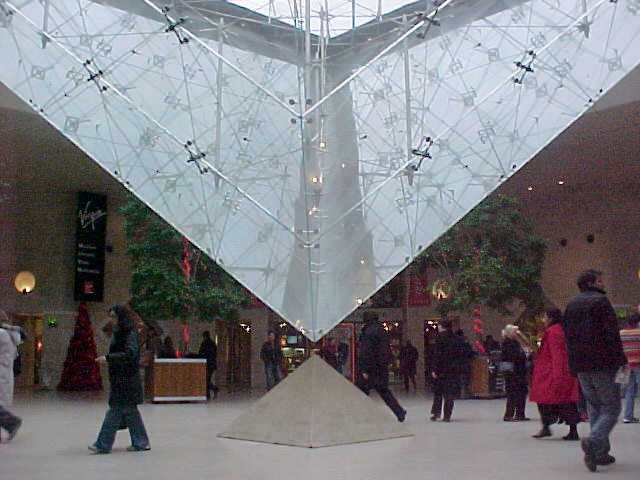
Day 1 – Plan on an inspiring combination of sightseeing and shopping with a visit to the Louvre, the neighboring Tuileries Garden and the Champs Elysées. The Louvre Museum and its glass pyramids juxtapose the beauty of Renaissance and modern architecture, while the commercial center under the pyramids will satisfy many of your shopping impulses. While browsing here, reflect upon the fact that African-American David Harmon was charged with completing a major part of the renovations done on the Louvre during the early 1990s.

Inverted pyramid in commercial center at the Louvre
© Discover Paris!

Emerge from the commercial center to view the splendid Arc de Triomphe du Carrousel and visit the Tuileries Garden, then head for place de la Concorde.

Arc de Triomphe du Carrousel
© Discover Paris!

Jardin des Tuileries
© Discover Paris!

Once at the place, take a moment to look at the Palais Bourbon across the river – home to the French equivalent of the U.S. House of Representatives, where distinguished politicians such as Martinique’s Aimé Césaire served and French Guiana’s Christiane Taubira continues to serve. Gaze upon the Luxor obelisk, where diva Jessye Norman sang France’s national anthem in celebration of the 200th anniversary of the French Revolution in 1989. Then look to the northwest corner of the square to see the Hôtel de Crillon, where Reginald Lewis launched his takeover of TLC Beatrice to become the first black billionaire in the history of the United States.

Obelisk of Luxor
© Discover Paris!

Proceed up the avenue des Champs Elysées for a look at its gardens dotted with pavilions that now serve as theaters and exclusive restaurants. Beyond the Rond Point (roundabout), the gardens give way to clubs, movie theaters and more restaurants and shopping as you approach the Arc de Triomphe.

Champs Elysées Gardens
© Discover Paris!

A detour onto avenue Montaigne will take you into the world of haute couture, where the greatest names in fashion await you. At the far end of this street is the Théâtre des Champs Elysées, where Josephine Baker and Sidney Bechet took Paris by storm in the wildly successful show La Revue Nègre in 1925.

Dior - avenue Montaigne and rue François I
© Discover Paris!

Théâtre des Champs Elysées
© Discover Paris!

Day 2 – Spend the day exploring areas frequented by famous African Americans in Paris. The 5th arrondissement (district) is home to the Sorbonne, where several conferences on African-American culture were held in the 1990s. Venues such as the Salle de la Mutualité where Malcolm X spoke and place de la Contrascarpe where Chester Himes frequented a favorite café are among many that are significant to African Americans. Plan to have lunch at an Ethiopian restaurant near the Sorbonne before taking a stroll past the bouquinistes (the book vendors along the Seine), where you might find a surprise gift for an art or literature aficionado back home. From the quay, you will have an excellent view of Notre-Dame, which so inspired Richard Wright upon his arrival in Paris in 1946.

Sorbonne
© Discover Paris!

Bouquiniste
© Discover Paris!

Notre Dame Cathedral
© Discover Paris!

A brief walk to the adjoining 6th arrondissement reveals sites such as the Odéon Theater where Ira Aldridge played Othello, the Café de Flore where James Baldwin socialized and rewrote Go Tell It on the Mountain, and the La Louisiane hotel that was home to numerous African-American jazzmen.

Théâtre de l'Odéon
© Discover Paris!

Café de Flore
© Discover Paris!

Consider complementing your promenade with a visit to the cafés and gourmet food shops on the rue de Buci to round out your brief but exhilarating stay in the City of Light.

************


Entrée to Black Paris!™ is a Discover Paris! blog.